


Can You Add Compost in November? Scotland Guide
Looking for compost, topsoil or garden supplies?
Browse our full product range or get in touch for delivery across Glasgow and Scotland.
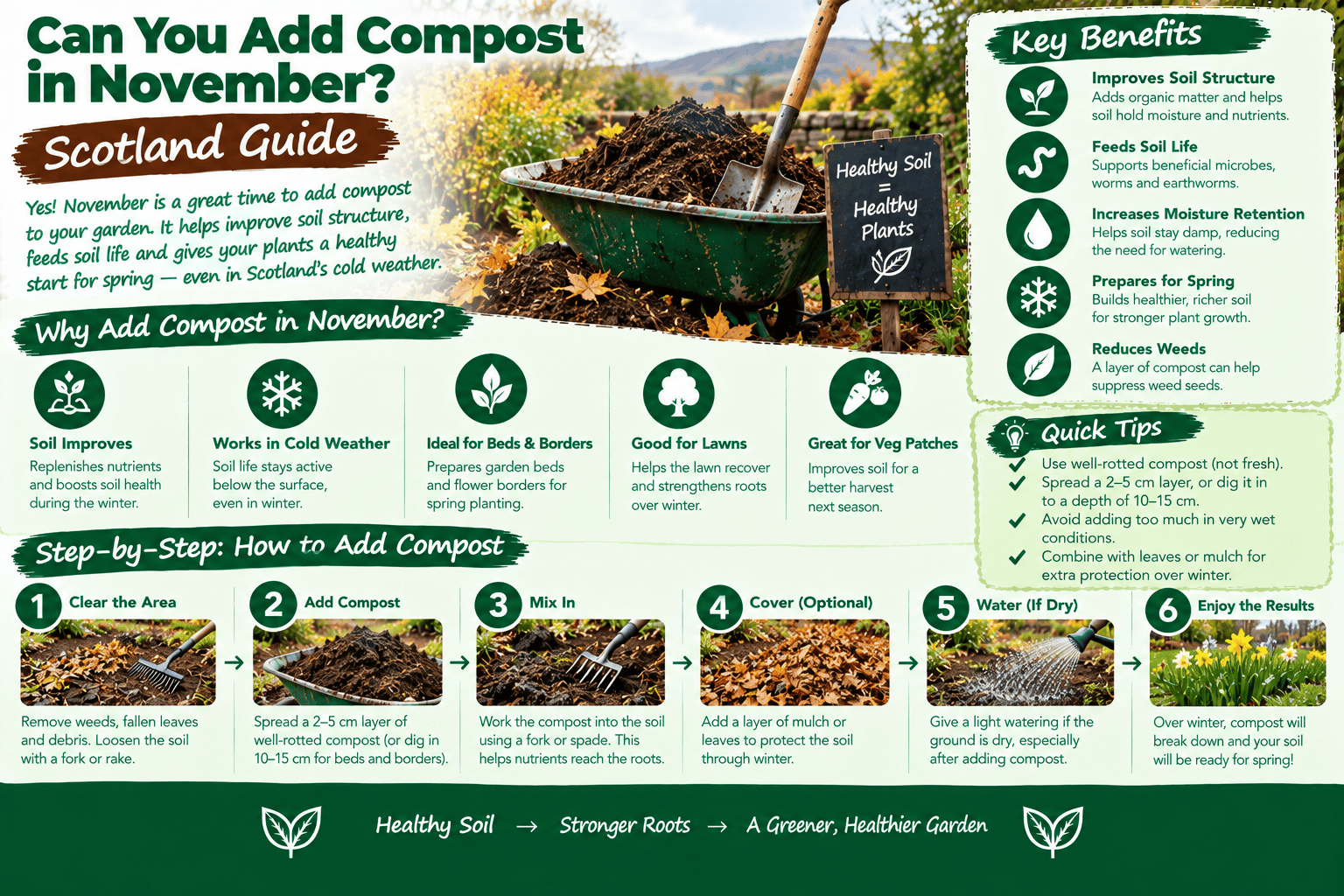
Can You Add Compost in November? A Scottish Gardener's Guide
November in Scotland can feel like the end of the gardening season.
The vegetable beds are mostly empty, the leaves are falling, and the ground is getting wetter with every passing week. You might have a bag of organic compost waiting to be used, or you're thinking about ordering some before winter arrives.
But is November actually a good time to add compost to your garden?
Yes, mature organic compost can be added to suitable garden beds in November, provided the ground isn't frozen or waterlogged. For many established beds, spreading compost on the surface is preferable to digging it into wet soil.
However, not every garden needs another application. The right decision depends on your soil, what you're growing and how much compost you've already added.
Here's how to make the most of compost during late autumn in Glasgow and across Scotland.
Is November Too Late to Add Compost?
No. Compost doesn't have to be applied during the main growing season.
Mature organic compost can be used to protect suitable soil surfaces and contribute organic matter over time.
In a no-dig garden, compost is commonly applied to the surface and left for soil organisms to incorporate gradually.
But November weather matters.
If the soil is saturated, walking across beds or digging can damage the soil structure.
If the ground is frozen, postpone the work.
The calendar isn't as important as the condition of the soil.
Why Add Organic Compost Before Winter?
Compost can provide several benefits when used appropriately.
Protecting exposed soil
Bare soil is exposed to rainfall and surface erosion.
A suitable layer of organic material can reduce the direct impact of rain.
Adding organic matter
Mature compost contributes organic matter, which supports soil structure and biological activity.
Preparing beds for spring
Applying compost to suitable beds in late autumn can reduce the amount of soil preparation needed when spring arrives.
Supporting no-dig gardening
Surface applications can help maintain no-dig beds without disturbing the soil unnecessarily.
These benefits don't mean that more compost is always better.
Repeated heavy applications can increase nutrient levels beyond what plants require.
Should You Dig Compost Into Soil in November?
Usually, there's no need to dig it into established beds simply because winter is approaching.
In many gardens, compost can be spread over the surface.
This is particularly practical when the soil is wet and difficult to work.
Digging saturated clay soil can smear and compact it, potentially making drainage and root growth worse.
If you're creating a completely new bed and incorporation is appropriate, wait until the soil is workable.
Can You Put Compost on Wet Soil?
Moist soil is generally suitable for mulching.
Waterlogged soil is different.
If water remains standing or the ground is extremely soft, avoid unnecessary foot traffic and cultivation.
Compost won't automatically solve an underlying drainage problem.
For persistently wet gardens, investigate compaction, soil layers and runoff before adding large quantities of material.
Is November a Good Time to Compost Vegetable Beds?
It can be.
After harvesting, some vegetable beds are left bare until spring.
A suitable application of mature compost may protect the surface and contribute organic matter.
However, consider what has already been added.
If the bed received substantial manure or compost earlier in the year, another heavy application may be unnecessary.
For productive beds, soil testing can help prevent excessive nutrient accumulation.
Should You Add Compost to Flower Borders in November?
Established flower borders may benefit from appropriate organic mulch.
Mature compost can be used where soil improvement is needed.
Spread it over the soil rather than piling it against stems or plant crowns.
Some ornamental plants prefer relatively lean soil, so avoid enriching every border indiscriminately.
Can You Add Compost Around Trees and Shrubs?
Yes, where suitable.
However, keep compost clear of trunks and woody stems.
Don't create deep mounds against the base of a tree.
For longer-lasting surface coverage, woodchip or bark may be more practical than fine compost.
Choose according to whether your priority is soil improvement or surface protection.
Is Compost Better Than Manure in November?
Both can contribute organic matter, but they have different characteristics.
Mature compost is commonly used as a soil improver and surface mulch.
Well-rotted manure may also be suitable for some beds, but its source, maturity and nutrient content matter.
Fresh manure requires particular care, especially around edible crops.
Neither product should be applied in unlimited quantities.
How Much Compost Should You Add in November?
There's no universal quantity for every garden.
A bed with low organic matter may benefit from a suitable application.
A bed that receives compost regularly may need much less.
Before ordering, calculate the area and decide on the appropriate depth.
Use:
Area in square metres × depth in metres × 1,000 = litres
For example, a 10m² bed at 2.5cm depth requires:
10 × 0.025 × 1,000 = 250 litres
Compost volume calculator
| Bed area | 1cm layer | 2.5cm layer |
|---|---|---|
| 5m² | 50L | 125L |
| 10m² | 100L | 250L |
| 20m² | 200L | 500L |
| 30m² | 300L | 750L |
| 50m² | 500L | 1,250L |
These are volume calculations, not recommended application rates for every soil.
Consider nutrient content and previous applications before choosing a depth.
How to Apply Compost in November
If your soil is suitable and compost is needed:
Remove persistent weeds and unwanted debris.
Check that the soil isn't frozen or saturated.
Use mature compost suitable for garden soil improvement.
Spread the intended quantity evenly.
Keep the material away from vulnerable stems and crowns.
Leave it on the surface where appropriate.
Avoid unnecessary walking on the bed afterward.
There's usually no need to dig the compost in immediately.
Should You Cover Compost After Applying It?
Generally, a suitable surface application can remain exposed as part of the garden mulch layer.
However, the material and site conditions matter.
On steep slopes or areas exposed to runoff, loose material may move during heavy rain.
If your garden has severe erosion or drainage problems, address those conditions rather than relying on compost alone.
Does Compost Work During Winter?
Organic matter continues to undergo biological processes, although decomposition generally slows in cold conditions.
Compost doesn't need to disappear into the soil immediately to be useful.
As conditions improve, soil organisms can gradually incorporate suitable material.
The pace depends on temperature, moisture, soil biology and the compost's characteristics.
Can Compost Protect Plants From Frost?
Organic mulch can help moderate soil temperature fluctuations.
However, compost isn't a guaranteed frost-protection solution for tender plants.
Some plants may need additional protection, such as horticultural fleece or relocation to a sheltered area.
Avoid burying crowns or stems beneath thick layers of material.
Should You Add Compost to a Lawn in November?
Not automatically.
Bulk organic soil-improving compost isn't necessarily suitable as lawn topdressing.
A lawn topdressing material needs appropriate particle size and composition.
Applying coarse or excessive compost can smother grass.
For lawn repair, choose materials and timing suited to the actual work.
Is November a Good Time to Start a Compost Heap?
Yes, you can continue composting garden and kitchen plant waste during autumn and winter.
However, cold weather may slow decomposition.
A balanced mix of suitable green and brown materials, adequate aeration and appropriate moisture can help the composting process.
Don't confuse unfinished homemade compost with mature compost ready for application.
Can You Use Compost in Raised Beds During November?
Yes, mature compost may be useful in suitable raised beds.
But don't assume that every raised bed needs topping up with pure compost.
Raised beds require an appropriate growing medium, and organic material can settle over time.
If the bed has lost substantial depth, assess whether it needs suitable topsoil, compost or a specified blend.
Should You Add Compost Before Planting Spring Bulbs?
Not necessarily.
Spring bulbs need suitable drainage and planting conditions.
Some bulbs tolerate a range of soils, while others are particularly sensitive to persistent wetness.
If the soil is already suitable, adding compost may be unnecessary.
Avoid creating overly rich or water-retentive pockets in poorly drained ground.
Compost in Glasgow: What About Heavy Rain?
Glasgow and western Scotland can experience prolonged wet periods in late autumn.
This makes soil condition especially important.
If the garden is saturated, postpone digging and avoid unnecessary foot traffic.
If the soil is moist but workable, a suitable surface application may be practical.
For gardens that regularly flood, drainage assessment should take priority over adding more organic material.
Buying Organic Compost in Glasgow Before Winter
For a small border, you may need only a modest quantity.
For a larger allotment or landscaping project, bulk delivery may be more convenient.
Before ordering:
Measure the area.
Confirm the intended application.
Check whether compost is actually needed.
Confirm the product's intended use.
Calculate the quantity.
Check delivery availability and unloading access.
Kelvin Compost supplies organic compost for suitable garden soil-improvement projects in Glasgow, East Kilbride, South Lanarkshire and surrounding areas.
Common November Composting Mistakes
Digging wet clay soil
This can damage soil structure.
Applying compost to waterlogged ground
Compost doesn't automatically fix poor drainage.
Adding too much compost
Excess nutrients may be unnecessary or harmful.
Using unfinished compost
Choose mature material appropriate for the application.
Piling compost against stems
Keep vulnerable plant bases clear.
Treating compost as topsoil
Compost primarily improves soil; topsoil provides mineral soil volume.
Applying compost automatically every year
Consider previous applications and soil fertility first.
Frequently Asked Questions
Can you add compost in November?
Yes, mature compost can be applied to suitable garden beds when the ground isn't frozen or waterlogged.
Is November too late to improve garden soil?
No. Suitable soil-improvement work can continue in late autumn, depending on conditions.
Should you dig compost into soil in winter?
Often, surface application is preferable in established beds, particularly when soil is wet.
Can you put compost on top of soil?
Yes. Mature compost can be used as a surface mulch where appropriate.
Does compost break down in winter?
Yes, although decomposition generally slows in colder conditions.
Can compost protect soil from winter rain?
Suitable mulch can help reduce direct rainfall impact and surface erosion.
Should you add compost to vegetable beds in autumn?
It can be useful, but consider soil fertility and previous applications.
Can you add too much compost?
Yes. Repeated heavy applications may cause nutrient imbalances.
Is compost better than manure in winter?
Neither is universally better. Choose according to soil needs and product characteristics.
Can you use compost around roses in November?
Suitable mature compost may be used around established roses, keeping it clear of stems and crowns.
Can you add compost to clay soil in November?
Yes, if appropriate, but avoid digging or trampling saturated clay.
How much compost do I need for 20m²?
At 2.5cm depth, approximately 500 litres. The appropriate application rate depends on soil needs.
Should I wait until spring to add compost?
If the soil is frozen, waterlogged or already nutrient-rich, waiting may be sensible.
Final Thoughts: November Can Be a Good Time, but Conditions Come First
November isn't automatically too late to add organic compost to your garden.
For suitable beds, mature compost can protect the soil surface and contribute organic matter over time.
But late-autumn gardening in Scotland requires a little flexibility.
If the soil is saturated, leave it alone.
If your beds have already received plenty of compost, don't add more simply because winter is approaching.
And if you do need compost, choose the right product and calculate the quantity before ordering.
The best November composting decision is the one that suits your soil—not just the calendar.
Need Organic Compost in Glasgow?
Kelvin Compost supplies organic compost, topsoil and other garden materials for homeowners, allotments and landscaping projects across Glasgow, East Kilbride, South Lanarkshire and surrounding areas.
Explore our organic compost or contact us to discuss your project and delivery requirements.
Phone: +44 7561 251350
Email: info@kelvincompost.co.uk
Need Garden Supplies Delivered in Glasgow?
Organic compost, topsoil, manure and more across Scotland