




Bulk Bag vs Loose Load | Compost & Topsoil Delivery Guide
Looking for compost, topsoil or garden supplies?
Browse our full product range or get in touch for delivery across Glasgow and Scotland.
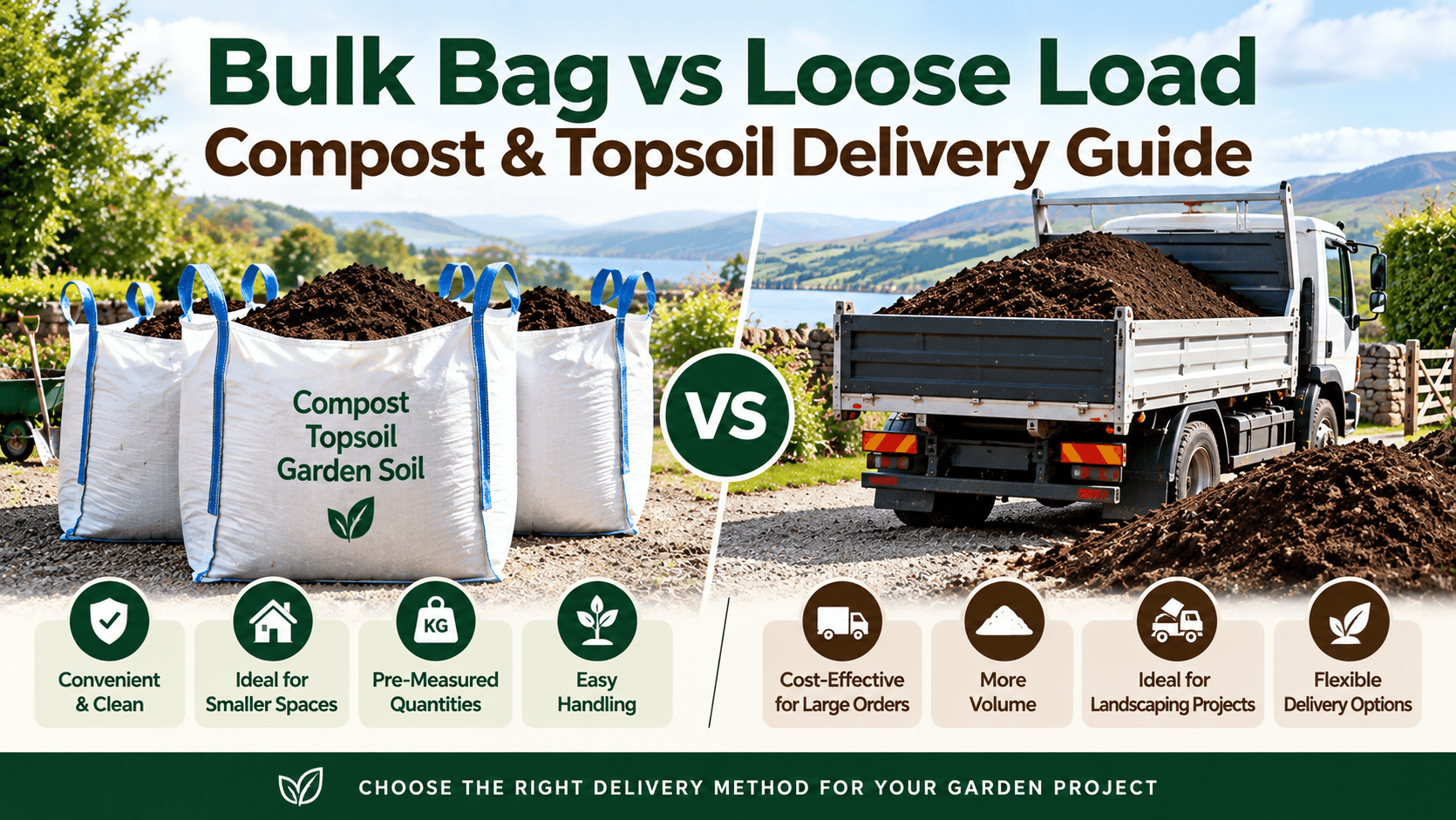
Bulk Bag vs Loose Load: What’s the Best Way to Order Compost or Topsoil?
When you need more than a few bags of compost or topsoil, buying from a garden centre one small bag at a time quickly becomes inconvenient.
For larger garden and landscaping projects, the choice usually becomes:
Should I order a bulk bag, or would a loose load make more sense?
There isn't one answer for every project.
A bulk bag can be convenient for a domestic garden because the material arrives contained and is easier to manage gradually. A loose load can make more sense when you're ordering several tonnes for a large landscaping, allotment, community or commercial project.
The right choice depends on:
- How much material you need
- Where it can be delivered
- Access to the property
- How quickly you'll use it
- Whether you have somewhere suitable for a loose load
- The type of compost, soil or mulch you're ordering
This guide explains the differences so you can choose the most practical option before placing an order.
Quick Answer: Bulk Bag or Loose Load?
For many domestic garden projects, a bulk bag is the easier option because the material stays contained after delivery.
A loose load is generally more practical when you need a much larger quantity and have a suitable area where the material can be tipped.
| Situation | Usually worth considering |
|---|---|
| Small-to-medium garden project | Bulk bag |
| Raised beds | Bulk bag |
| Improving several borders | Bulk bag |
| Lawn renovation | Bulk bag or loose |
| Large landscaping project | Loose load |
| Large allotment/community project | Loose load |
| Several tonnes required | Loose load |
| Limited storage area | Bulk bag |
| Material needs to remain contained | Bulk bag |
| Suitable tipping area available | Loose load |
The actual delivery option will also depend on the product, quantity and site access.
What Is a Bulk Bag?
A bulk bag is a large woven bag used to deliver materials such as:
- Compost
- Topsoil
- Manure
- Woodchip
- Landscaping materials
Unlike dozens of small retail bags, the material arrives together in one large container.
For a homeowner, one of the biggest advantages is simple:
the material stays in one place.
You can use some on Saturday, continue on Sunday and finish the following weekend without having a loose pile spread across the driveway.
Kelvin Compost supplies many garden materials in bulk quantities for customers around Glasgow, East Kilbride, South Lanarkshire and surrounding areas.
What Is a Loose Load?
With a loose delivery, the material isn't contained inside individual bulk bags.
Instead, the compost, soil or other material is delivered loose and tipped at an agreed suitable location where delivery conditions permit.
This becomes particularly useful when you're dealing with substantial quantities.
Think:
one garden border
versus
an entire landscaping project.
Moving 500–1,000 litres is one thing.
Moving many tonnes is another.
For sufficiently large projects, loose delivery can significantly reduce the amount of packaging involved and may be a more practical way of receiving the material.
Bulk Bag vs Loose Load: What's the Difference?
The material itself may be the same or similar depending on the product you're ordering.
The major difference is how you receive and manage it.
Bulk bag
The material arrives contained.
That makes it easier to:
- Keep the driveway tidier
- Store material temporarily
- Use it gradually
- Separate different products
- Control where the pile spreads
Loose load
The material arrives without a bag.
That can be useful because:
- Large quantities can be delivered efficiently
- There are fewer individual bags to handle
- It's practical for machinery-assisted landscaping
- Large projects can receive material in fewer deliveries
But you need somewhere suitable for it to go.
When Is a Bulk Bag Better?
A bulk bag is particularly useful when you're working on a domestic garden.
For example:
Improving flower borders
If you're adding organic matter across several borders, a bulk bag keeps the compost together while you move it around the garden.
Filling or topping up raised beds
You can work through the material gradually without needing to deal with a large loose pile.
Repairing a lawn
Screened topsoil can be moved from the delivery point to the lawn as required.
Weekend projects
You don't necessarily need to use the entire delivery immediately.
Properties where tidiness matters
Contained material can be much easier to manage than a loose pile.
For many homeowners, convenience rather than maximum delivery volume is the deciding factor.
When Is a Loose Load Better?
Loose loads start to become attractive as project size increases.
Examples include:
- Large landscaping projects
- New gardens
- Large lawns
- Community gardens
- Schools
- Allotments
- Farms
- Commercial landscaping
- Large-scale soil improvement
- Multiple raised beds
- Large planting schemes
If you're moving material with machinery, receiving it loose may also be more convenient.
Kelvin Compost can supply larger quantities, including 10- and 20-tonne loose loads for suitable projects, subject to product, location and access.
If you're unsure whether your project is large enough for loose delivery, calculate the volume first rather than guessing.
How Much Material Do I Actually Need?
This should be your first calculation.
Use:
Length × Width × Depth = Volume
Make sure all measurements are in metres.
Example 1: Small border
A border measuring:
5m × 2m
has an area of:
10m²
If you apply compost at 5cm:
10 × 0.05 = 0.5m³
That's approximately:
500 litres.
A bulk quantity is already considerably easier than carrying lots of small bags.
Example 2: Larger Garden
Suppose you're improving:
30m²
at a depth of:
5cm
Calculation:
30 × 0.05 = 1.5m³
That's approximately:
1,500 litres.
At this point, you may be considering multiple bulk bags or discussing a larger delivery.
Example 3: Large Landscaping Project
Suppose you're creating a planting area measuring:
100m²
and need:
15cm of soil
Calculation:
100 × 0.15 = 15m³
That's:
15,000 litres of material.
This is no longer a small domestic bagging job.
A larger delivery arrangement may be substantially more practical.
Garden Material Calculator
| Area | 5cm depth | 10cm depth | 15cm depth |
|---|---|---|---|
| 10m² | 500L | 1,000L | 1,500L |
| 20m² | 1,000L | 2,000L | 3,000L |
| 30m² | 1,500L | 3,000L | 4,500L |
| 50m² | 2,500L | 5,000L | 7,500L |
| 75m² | 3,750L | 7,500L | 11,250L |
| 100m² | 5,000L | 10,000L | 15,000L |
| 200m² | 10,000L | 20,000L | 30,000L |
These figures calculate volume only.
The relationship between litres, cubic metres and tonnes depends on the material because different materials have different densities and moisture contents.
Don't automatically assume 1m³ equals one tonne.
That's particularly important when comparing compost, topsoil, manure and woodchip.
How Much Does an 850-Litre Bulk Bag Cover?
If you're ordering an approximately 850-litre bulk bag, we can calculate its theoretical coverage.
850 litres = 0.85m³.
At a depth of 5cm:
0.85 ÷ 0.05 = 17m²
At 7.5cm:
0.85 ÷ 0.075 ≈ 11.3m²
At 10cm:
0.85 ÷ 0.10 = 8.5m²
So approximately:
| Application depth | Theoretical coverage from 850L |
|---|---|
| 2.5cm | 34m² |
| 5cm | 17m² |
| 7.5cm | 11.3m² |
| 10cm | 8.5m² |
| 15cm | 5.7m² |
| 20cm | 4.25m² |
Real-world requirements can vary because of settlement, uneven ground and how the material is applied.
Don't Confuse Litres With Tonnes
This is an important point when ordering bulk garden materials.
A litre measures volume.
A tonne measures weight.
One cubic metre equals:
1,000 litres
but it does not automatically equal one tonne.
For example, woodchip is far lighter by volume than wet topsoil.
The weight of material can also vary with moisture content.
So when comparing:
850L bulk bag
with
10-tonne loose load
you aren't comparing two directly interchangeable measurements.
Tell the supplier what you're trying to cover and at what depth.
That makes choosing the right quantity much easier.
Which Is Better for Compost?
For many home gardeners, bulk bags are a convenient way to order Organic Compost.
Bulk compost can be used for suitable:
- Beds
- Borders
- Raised beds
- Vegetable gardens
- Allotments
- Soil improvement
- Mulching
For a large community garden, allotment or landscaping project, a loose load may become more practical.
The deciding factor should be project size and access, not simply the fact that the product is compost.
Which Is Better for Topsoil?
Topsoil is often required in much larger volumes than compost.
Why?
Because topsoil is commonly used when you need to create or restore actual soil depth.
For example, a 50m² garden requiring an additional 15cm needs:
50 × 0.15 = 7.5m³
or:
7,500 litres.
Large lawn and landscaping projects can therefore move into loose-load territory much faster than routine compost applications.
For smaller lawn repairs, borders or raised beds, bulk bags may still be easier.
What About Manure?
Well-Rotted Manure is commonly used for:
- Vegetable beds
- Allotments
- Hungry crops
- Soil improvement
- Suitable established planting areas
For a normal garden, a bulk bag can be convenient because you can distribute it gradually.
For larger agricultural, allotment or landscaping requirements, ask about the most appropriate bulk-delivery option.
Remember that manure should be used according to the crops and soil you're working with.
More isn't automatically better.
What About Woodchip?
Organic Woodchips can be required in surprisingly large volumes.
That's because effective mulch layers are several centimetres deep.
Suppose you're covering:
100m²
at:
7.5cm
Calculation:
100 × 0.075 = 7.5m³
That's:
7,500 litres of woodchip.
Projects involving:
- Long paths
- Play areas where appropriate material is specified
- Community gardens
- Orchards
- Large shrub beds
- Landscaping
can therefore require substantial quantities.
Bulk Bags Are Useful When You Need Different Materials
Suppose you're renovating a garden and need:
- Topsoil for a lawn
- Compost for borders
- Manure for vegetable beds
- Woodchip around shrubs
Receiving each material separately in bulk bags can make managing the project easier.
You know what's what.
A loose-load delivery is more appropriate when you're receiving a large quantity of one material and have an appropriate area available for it.
Think About Delivery Access Before Ordering
Quantity isn't the only consideration.
A delivery vehicle needs suitable access.
Before ordering, consider:
- Road width
- Gate width
- Parked vehicles
- Overhead cables
- Overhanging trees
- Delivery surface
- Weight restrictions
- Space for unloading
- Whether the delivery point is on private property
- Whether a loose load can safely be tipped
Never assume a delivery vehicle can place material exactly beside your flower bed.
Discuss unusual or restricted access before ordering.
Kelvin Compost also operates a small HIAB, which can be useful where access requires a more compact delivery solution, subject to the individual site.
Where Can a Bulk Bag Be Placed?
This depends on vehicle access and safe unloading conditions.
A convenient location might be:
- A driveway
- A suitable hardstanding
- Another accessible private area
Don't assume the bag can be lifted:
- Over a house
- Through a garage
- Over tall walls
- Across parked vehicles
- Through narrow pedestrian gates
If placement matters, discuss it before delivery rather than after the vehicle arrives.
Where Can a Loose Load Be Tipped?
Loose loads require even more planning.
Once tonnes of material are tipped, they're not easy to move.
You need an appropriate location where:
- The vehicle can access safely
- Tipping is permitted and practical
- The material won't obstruct traffic
- The pile won't block neighbours
- Drainage won't wash material away
- You can move the material from the pile to the work area
For a large project, thinking about logistics beforehand can save hours of unnecessary wheelbarrow work.
Can Material Be Delivered on the Road or Pavement?
Don't assume it can.
Public roads, pavements and verges may be subject to local restrictions or permissions.
The safest approach is to arrange a suitable delivery point on private property wherever possible.
If you're unsure about delivery access, speak to Kelvin Compost before placing the order.
How Long Can Compost Stay in a Bulk Bag?
Ideally, use garden materials reasonably soon after delivery rather than treating the bag as permanent storage.
If you need to keep material temporarily:
- Keep the delivery area accessible
- Avoid allowing the bag to become damaged
- Don't allow contaminated material to be added
- Use the product appropriately
- Follow any product-specific storage guidance
Bulk bags are convenient for temporary project storage, but your driveway doesn't need to become a compost warehouse for the next two years.
Is a Bulk Bag Cheaper Than Small Bags?
The relevant comparison isn't only the sticker price.
Consider:
- Total volume
- Delivery
- Time
- Transport
- Number of journeys
- Packaging
- Manual handling
- Project convenience
For a tiny container garden, small bags may be perfectly sensible.
For a 100m² landscaping project, buying everything in 40-litre bags can become impractical very quickly.
Choose the format that fits the scale of the job.
When Should You Move From Bulk Bags to a Loose Load?
There isn't one universal number because:
- Products have different densities
- Delivery options vary
- Access varies
- Projects differ
But if your calculations show you need several cubic metres or many tonnes, it's worth asking whether a loose delivery would be more practical.
Instead of automatically ordering six, ten or twenty individual bulk bags, give Kelvin Compost the project dimensions.
For example:
“I have a 120m² area and need approximately 10cm of topsoil.”
That's much more useful than:
“How many bags do I need?”
The area and required depth allow the volume to be calculated properly.
Bulk Bag vs Loose Load for Different Projects
| Project | Bulk bag | Loose load |
|---|---|---|
| Small flower border | ✓ | — |
| Several garden borders | ✓ | Maybe |
| One or two raised beds | ✓ | — |
| Multiple large raised beds | ✓ | ✓ |
| Lawn patch repair | ✓ | — |
| New large lawn | ✓ | ✓ |
| Domestic vegetable garden | ✓ | Maybe |
| Large allotment project | ✓ | ✓ |
| Community garden | ✓ | ✓ |
| School growing project | ✓ | ✓ |
| Large landscaping project | Maybe | ✓ |
| Farm/large-scale requirement | — | ✓ |
This isn't a strict rule.
Access and quantity can completely change the answer.
Common Bulk-Ordering Mistakes
1. Guessing the quantity
Measure the area first.
2. Confusing tonnes with cubic metres
Weight and volume aren't interchangeable.
3. Forgetting depth
A 100m² garden tells us only the area.
We still need to know whether you're applying 2.5cm or 20cm.
4. Ordering compost when you need topsoil
Compost improves soil.
Topsoil provides actual soil volume.
They're not interchangeable.
5. Ignoring vehicle access
A delivery option is only useful if the vehicle can safely access the site.
6. Having nowhere to put a loose load
Several tonnes of soil require a suitable tipping location.
7. Ordering too little
Running out halfway through a project can mean another delivery.
8. Ordering far too much
Extra material still needs somewhere to go.
A five-minute calculation before ordering can prevent both problems.
Bulk Compost & Topsoil Delivery in Glasgow
Kelvin Compost supplies bulk garden materials for projects across Glasgow, East Kilbride, South Lanarkshire and surrounding areas.
Products include:
Bulk bags are suitable for many domestic and medium-sized garden projects.
For larger requirements, Kelvin Compost can also supply 10- and 20-tonne loose loads where suitable, subject to material, delivery location and site access.
Frequently Asked Questions
Is a bulk bag better than a loose load?
It depends on quantity and access. Bulk bags are convenient for many domestic projects because the material remains contained. Loose loads can be more practical for larger projects requiring several tonnes.
How much does an 850L bulk bag cover?
Theoretically, approximately 17m² at 5cm depth, 11.3m² at 7.5cm, or 8.5m² at 10cm.
Is 850 litres the same as 850kg?
No. Litres measure volume and kilograms measure weight. The weight of 850 litres varies substantially depending on the material and moisture content.
Is one cubic metre one tonne?
Not necessarily. One cubic metre is 1,000 litres of volume. Its weight depends on the density of the material.
Should I buy compost or topsoil?
Choose compost when suitable existing soil needs organic matter and improvement. Choose topsoil when you need additional actual soil volume or depth.
Can I get bulk compost delivered in Glasgow?
Kelvin Compost supplies bulk garden materials across Glasgow, East Kilbride, South Lanarkshire and surrounding areas, subject to delivery availability and access.
Are loose loads available?
Kelvin Compost can supply larger loose loads, including 10- and 20-tonne quantities for suitable requirements. Confirm product availability, delivery location and access before ordering.
How do I calculate how much soil I need?
Multiply:
length × width × required depth
using metres.
The result is cubic metres.
Multiply cubic metres by 1,000 to convert the figure to litres.
Is a bulk bag suitable for a raised bed?
Yes, depending on the size of the bed and material required. Calculate the bed's internal length × width × required fill depth before ordering.
What should I check before arranging a loose delivery?
Check vehicle access, unloading space, overhead obstructions, the tipping location and how you'll move the material once delivered.
Bulk Bag or Loose Load? Start With the Measurements
Don't choose your delivery format first.
Start with the project.
Measure:
Length × width × required depth.
Then decide which material you actually need.
Organic Compost for suitable soil improvement.
Topsoil when you need additional soil volume.
Well-Rotted Manure for appropriate productive growing areas.
Woodchip for suitable mulching and landscaping applications.
Once you know the material and quantity, it's much easier to determine whether bulk bags or a loose load make sense.
Need Help With a Bulk Order?
Browse Kelvin Compost's garden products or get in touch before ordering a large quantity.
Call: +44 7561 251350
Email: info@kelvincompost.co.uk
If you're unsure how much you need, have your area dimensions and required depth ready. Those measurements are the fastest way to calculate the right quantity.
Need Garden Supplies Delivered in Glasgow?
Organic compost, topsoil, manure and more across Scotland