


Best Winter Mulch for Scottish Gardens: UK Guide
Looking for compost, topsoil or garden supplies?
Browse our full product range or get in touch for delivery across Glasgow and Scotland.
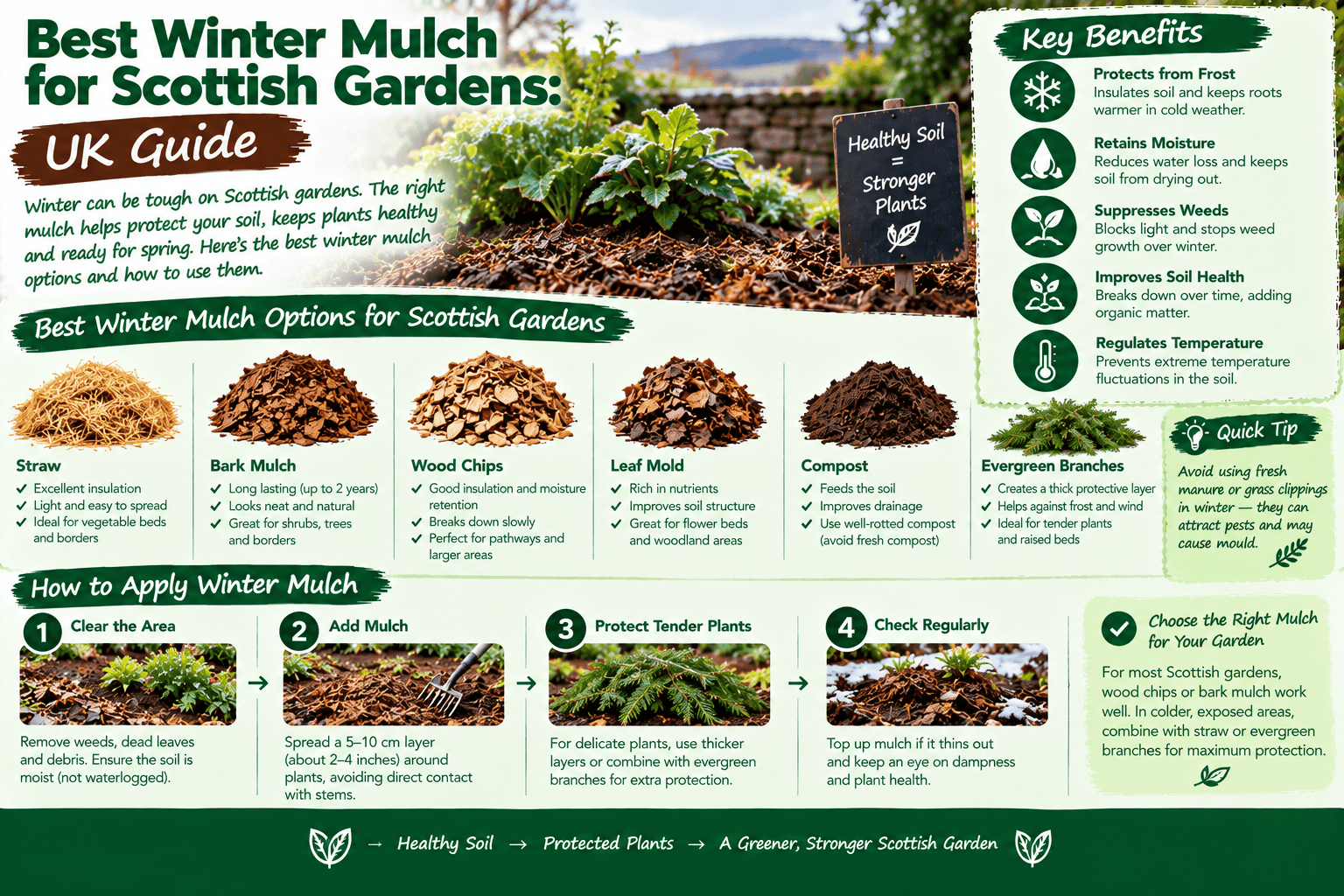
Best Mulch for Winter in Scotland: Compost, Woodchip or Bark?
By late autumn, many Scottish gardens are looking a little tired. Summer flowers have faded, vegetable beds are empty, and the soil is exposed to months of rain, wind and changing temperatures.
You might be wondering whether it's worth putting mulch down before winter.
And if it is, what should you use?
Organic compost? Woodchip? Bark? Or should you simply leave the soil alone until spring?
For most established Scottish garden borders, suitable organic mulch can help protect the soil through winter. Mature compost is particularly useful where soil improvement is the priority, while woodchip and bark often provide longer-lasting surface cover around shrubs and trees.
But the best material depends on the plants, the soil and how wet the garden becomes.
Here's how to choose without wasting money or creating new problems.
Quick Answer: What's the Best Mulch for Winter?
| Garden area | Mulch worth considering | Main reason |
|---|---|---|
| Established flower borders | Mature compost or bark | Soil protection and weed suppression |
| Shrubs and hedges | Woodchip or bark | Longer-lasting surface cover |
| Established trees | Coarse woodchip | Protects surrounding soil |
| Empty vegetable beds | Mature compost | Adds organic matter |
| Allotment paths | Coarse woodchip | Practical walking surface |
| Waterlogged ground | Investigate drainage first | Mulch doesn't fix standing water |
| Newly sown beds | Use caution | Thick mulch may obstruct seedlings |
These are general choices, not rules for every plant.
For example, some plants prefer lean, free-draining soil and may not benefit from repeated applications of nutrient-rich compost.
Why Mulch a Garden Before Winter?
Winter mulching is about more than keeping the garden tidy.
A suitable mulch layer can help:
Protect bare soil from heavy rain.
Reduce erosion and surface crusting.
Moderate soil temperature changes.
Reduce moisture evaporation during dry periods.
Suppress some weed germination.
Add organic matter as it decomposes.
In Glasgow and western Scotland, protecting exposed soil can be particularly useful during wet months.
However, mulch won't correct severe drainage defects or prevent every type of winter damage.
Is Organic Compost a Good Winter Mulch?
Yes, mature organic compost can be a useful winter mulch in suitable garden beds.
It's especially helpful where you want to improve the soil over time.
As the material breaks down and is incorporated through biological activity, it contributes organic matter to the upper soil.
This makes compost a practical choice for vegetable beds and established borders.
However, compost is not simply a decorative covering.
It can contain substantial nutrients, so repeated heavy applications may be unnecessary or excessive.
If your garden has received plenty of compost in recent years, consider whether another substantial layer is needed.
Best uses for compost mulch
Mature compost is particularly useful for:
Established vegetable beds.
Allotments.
Suitable flower borders.
Soil-improvement projects.
No-dig growing systems.
Explore Kelvin Compost's organic compost if you're planning a larger soil-improvement project.
Is Woodchip Better Than Compost for Winter?
Sometimes.
Woodchip generally breaks down more slowly than fine, mature compost.
That makes it practical where you want a surface covering that lasts longer.
For established shrubs, hedges and trees, suitable coarse woodchip is often a good choice.
It can protect exposed soil while reducing the need for frequent replacement.
Best uses for woodchip
Woodchip is often suitable for:
Established shrub borders.
Trees.
Hedges.
Informal garden paths.
Allotment walkways.
Keep woodchip away from trunks and stems.
Avoid piling it into a mound around the base of a tree.
You can explore Kelvin Compost's woodchip for suitable landscaping applications.
What About Bark Mulch?
Bark mulch is another useful option for winter.
It is commonly chosen for its appearance and relatively long-lasting surface coverage.
Compared with mixed arborist woodchip, decorative bark products may have a more uniform appearance.
This can make bark attractive for front gardens and ornamental borders.
However, product characteristics vary.
Check whether the material is suitable for the intended plants and location.
Compost vs Woodchip vs Bark: Which Should You Buy?
| Feature | Mature compost | Woodchip | Bark mulch |
|---|---|---|---|
| Soil improvement | Strong focus | Gradual contribution | Gradual contribution |
| Long-lasting cover | Usually shorter-lived | Often longer-lasting | Often longer-lasting |
| Vegetable beds | Often useful | More selective use | More selective use |
| Shrubs and trees | Can be suitable | Very practical | Very practical |
| Garden paths | Generally unsuitable | Often suitable | Depends on grade |
| Decorative finish | Natural, soil-like | Rustic | Often uniform |
| Nutrient contribution | Can be substantial | Usually slower release | Usually slower release |
If your priority is improving the soil, compost may be the better purchase.
If your priority is longer-lasting ground coverage, woodchip or bark may be more practical.
How Deep Should Winter Mulch Be?
The appropriate depth depends on the material and application.
For many organic mulches, the RHS recommends a layer of at least 5cm.
However, that doesn't mean every garden needs a 5cm layer of nutrient-rich compost every year.
Consider the existing soil, plant requirements and previous applications.
Keep mulch clear of vulnerable stems and plant crowns.
For woody plants, spread it over the surrounding soil rather than against the trunk.
Can Mulch Make a Wet Garden Worse?
Mulch can help protect soil, but it doesn't solve underlying drainage problems.
If a garden is persistently waterlogged, investigate the cause before applying a substantial layer.
Waterlogging may result from:
Compacted soil.
Poor grading.
An impermeable layer beneath the surface.
Water entering from surrounding areas.
Inadequate drainage.
Covering the problem with mulch may make the garden look tidier without improving root conditions.
For saturated soil, wait until conditions are suitable before carrying out substantial garden work.
Should You Mulch Before or After the First Frost?
There's no single ideal date for every Scottish garden.
Autumn is often a convenient time to mulch because beds are being cleared and soil is still workable.
For winter protection, aim to apply suitable mulch before prolonged freezing conditions, where appropriate.
However, don't spread it simply because the calendar says October or November.
Check the weather, soil moisture and plant requirements.
Can You Mulch Flower Beds in November?
Yes, provided conditions are suitable.
November can be a useful time to protect exposed soil in established borders.
But in Glasgow, prolonged rainfall can leave beds saturated.
Avoid unnecessary digging or trampling when the soil is wet.
If the ground is waterlogged, postpone the work.
Is Mulching Good for Vegetable Gardens in Winter?
It can be.
Empty vegetable beds are often left exposed after harvesting.
A suitable layer of mature compost may help protect the surface and contribute organic matter over time.
In a no-dig system, the compost is usually left on the surface.
However, nutrient requirements matter.
If your soil already has high phosphorus or other nutrient levels, repeated heavy compost applications may be inappropriate.
A soil test can help guide future applications.
Should You Put Woodchip on Vegetable Beds?
Use caution.
Coarse woodchip is generally more straightforward for paths between growing areas than for seedbeds or areas containing small annual vegetables.
Fresh woody material can create particular issues if mixed into soil, including temporary nitrogen immobilisation.
Surface application is different from incorporation, but you should still consider the crop and the material.
For productive beds, mature compost is often a more practical choice.
Can You Mulch Around Roses in Winter?
Yes, suitable organic mulch can be used around established roses.
However, keep it away from the stems and avoid burying the crown.
Choose a material that suits the soil and planting conditions.
If your roses are growing in poorly drained ground, investigate that issue rather than relying on mulch to solve it.
Is Woodchip Good Around Trees in Winter?
Yes, suitable woodchip can protect the soil around established trees.
Spread it in a broad, relatively even layer over the surrounding root zone where practical.
Avoid the common mistake of creating a deep mound against the trunk.
That practice is sometimes called volcano mulching and can contribute to bark and root problems.
The aim is to cover the soil, not bury the tree.
Does Winter Mulch Stop Weeds?
Mulch can suppress some weed germination by reducing light reaching the soil surface.
However, it won't eliminate every weed.
Persistent perennial weeds may grow through the mulch.
New weed seeds can also arrive later.
For the best results, remove established weeds before mulching and maintain the area as needed.
Does Mulch Protect Plants From Frost?
Mulch can help moderate soil temperature fluctuations and provide some insulation around roots.
However, it doesn't guarantee protection from severe frost.
The degree of protection depends on the material, depth, plant species and weather.
For tender plants, additional protection or moving containers to a sheltered location may be necessary.
How Much Mulch Do You Need?
Calculate the quantity before ordering.
Use the formula:
Area (m²) × depth (m) = volume (m³)
For example, a 20m² border covered to a depth of 5cm requires:
20 × 0.05 = 1m³, or 1,000 litres.
Winter mulch quantity guide
| Garden area | 5cm depth | 7.5cm depth |
|---|---|---|
| 5m² | 250L | 375L |
| 10m² | 500L | 750L |
| 20m² | 1,000L | 1,500L |
| 30m² | 1,500L | 2,250L |
| 50m² | 2,500L | 3,750L |
These are theoretical volumes. Allow for uneven ground and set
tlement where appropriate.
If you're ordering bulk bags, confirm their actual capacity.
Should You Remove Old Mulch Before Adding New?
Not always.
If the existing mulch is suitable, clean and not excessively deep, you may only need to top it up.
Remove weeds and unwanted debris first.
Check whether the existing layer is already thick enough.
Avoid automatically adding another substantial layer every year.
With compost mulch, repeated applications can also increase soil nutrient levels.
Can You Mix Compost and Woodchip?
They can be used together in suitable situations.
For example, mature compost may be applied as a soil improver, with woodchip used as a longer-lasting surface covering around established shrubs.
However, avoid applying excessive total depth.
There's no need to combine multiple thick layers simply because both products are available.
Winter Mulching in Glasgow: What Should You Consider?
Gardens in Glasgow, East Kilbride and South Lanarkshire vary considerably.
Some have heavy clay-rich soil.
Others contain imported topsoil, sandy areas or raised beds.
The right mulch depends on the actual growing conditions.
Before ordering, consider:
Whether the soil drains adequately.
What plants are growing.
Whether you want soil improvement or surface coverage.
How much area needs mulching.
Whether bulk delivery is practical.
How the material will be unloaded.
For larger landscaping projects, buying in bulk can be convenient, but compare actual product volumes and total delivered costs.
Common Winter Mulching Mistakes
Mulching waterlogged soil without addressing drainage
Mulch doesn't correct severe waterlogging.
Piling mulch against trunks
Keep the base of woody plants clear.
Applying too much compost
Excess nutrients may be harmful or unnecessary.
Using woodchip in the wrong place
Choose materials according to the plants and intended use.
Ignoring existing mulch
Check whether the bed already has adequate coverage.
Working frozen or saturated ground
Wait for suitable conditions.
Confusing compost with topsoil
Compost adds organic matter; topsoil provides mineral soil volume.
Frequently Asked Questions
What is the best mulch for winter in Scotland?
Mature compost can be useful for soil improvement, while woodchip and bark are often practical for longer-lasting coverage around shrubs and trees.
Should I mulch my garden in autumn?
Autumn is often a convenient time, provided the soil and weather conditions are suitable.
Is compost or woodchip better for winter?
Compost is useful for adding organic matter, while woodchip often lasts longer as a surface covering.
Can I mulch in November?
Yes, if the ground is workable and not waterlogged or frozen.
How thick should winter mulch be?
Around 5cm is a common starting point for many organic mulches, but the appropriate depth depends on the material and plants.
Can mulch prevent frost damage?
It can moderate soil temperature changes, but it doesn't guarantee protection from severe frost.
Can you put mulch on wet soil?
Moist soil is often suitable for mulching, but avoid working saturated or waterlogged ground.
Does mulch stop weeds growing in winter?
It can suppress some weeds, but not all.
Can I use compost as winter mulch?
Yes, mature compost can be used on suitable garden beds.
Is woodchip good for winter?
Yes, particularly around established trees, shrubs and suitable paths.
Can I use bark mulch in winter?
Yes. Bark can provide longer-lasting surface coverage in ornamental beds.
Should I remove mulch in spring?
Not necessarily. Suitable organic mulch can remain in place and gradually decompose.
How much mulch do I need for 20m²?
At 5cm depth, approximately 1,000 litres.
Can I mulch around roses?
Yes, but keep mulch clear of stems and crowns.
Can too much mulch damage plants?
Yes. Excessive depth or material piled against plant bases can cause problems.
Final Thoughts: Choose the Mulch That Fits Your Garden
Winter mulching is a practical way to protect suitable garden soil during the colder months.
But there's no single product that works best everywhere.
Choose mature organic compost when improving the soil is your priority.
Choose woodchip or bark when you want longer-lasting coverage around established shrubs, trees or paths.
And if your garden is regularly waterlogged, investigate drainage before adding more material.
The right mulch, applied at the right depth, is more useful than simply putting down as much as possible.
Buy Organic Compost or Woodchip in Glasgow
Kelvin Compost supplies organic compost, woodchip, topsoil and other garden materials for homeowners, allotments and landscaping projects across Glasgow, East Kilbride, South Lanarkshire and surrounding areas.
Explore our products:
For quantities and delivery enquiries:
Phone: +44 7561 251350
Email: info@kelvincompost.co.uk
Need Garden Supplies Delivered in Glasgow?
Organic compost, topsoil, manure and more across Scotland