



Best Topsoil for Gardens, Lawns & Raised Beds | Kelvin Compost
Looking for compost, topsoil or garden supplies?
Browse our full product range or get in touch for delivery across Glasgow and Scotland.
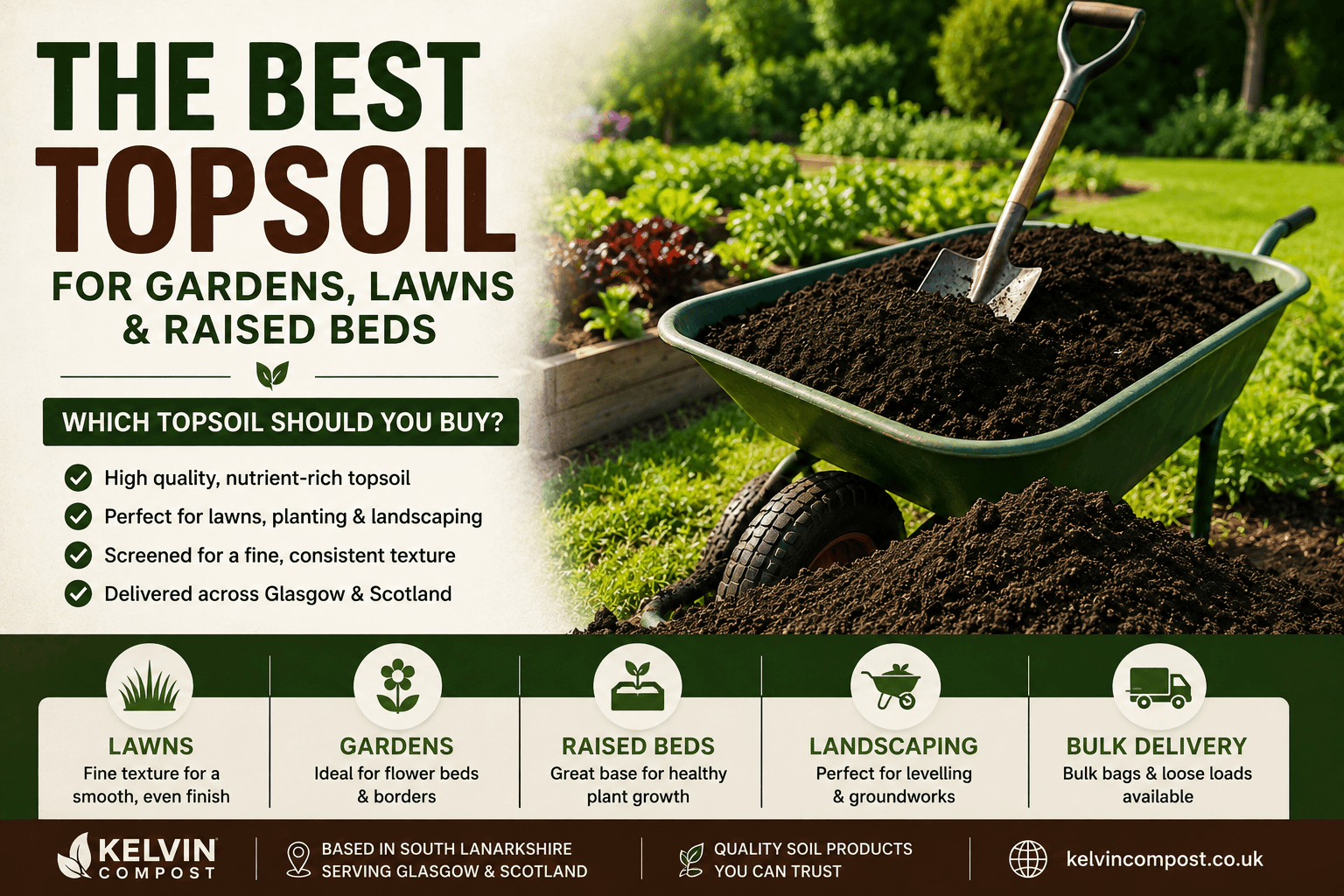
If you are looking for the best topsoil for a garden, lawn, raised bed or landscaping project, the right choice depends on what you are using it for.
Screened topsoil is generally a good choice when you need a finer, more consistent material for lawns, planting areas and garden beds. General-purpose topsoil can be suitable for many everyday landscaping and gardening projects, while economy-grade material is more appropriate when large quantities are needed for filling or raising ground levels.
The important thing is not simply buying the most expensive soil. You need to choose topsoil that matches your project, required depth, quality requirements and budget.
Kelvin Compost supplies topsoil, compost, manure, woodchip and soil products for gardens, allotments, schools, farms and landscaping projects across Glasgow and surrounding areas.
What Is Topsoil?
Topsoil is the upper layer of soil used for growing plants, creating new beds, preparing lawns and landscaping.
It contains mineral particles and organic matter that provide a growing environment for plant roots.
You may need additional topsoil when:
- Creating a new garden bed
- Building raised beds
- Preparing a new lawn
- Laying turf
- Improving poor or damaged ground
- Raising ground levels
- Landscaping a garden
- Replacing soil removed during construction
The RHS identifies new beds, borders, raised beds and lawns as some of the main applications for purchased topsoil.
Topsoil is not the same as compost.
Topsoil provides soil volume and structure, while compost is primarily used to add organic matter and improve existing soil.
What Is the Best Topsoil?
There is no single topsoil that is best for every project.
The best option depends on what you are trying to achieve.
| Project | Recommended topsoil |
|---|---|
| New lawn | Screened or turf-grade topsoil |
| Flower borders | Quality premium or general-purpose topsoil |
| Vegetable beds | Quality topsoil with suitable organic matter |
| Raised beds | Screened topsoil combined with compost where appropriate |
| Landscaping | General-purpose topsoil |
| Raising ground levels | Economy or general-purpose grade, depending on the project |
| Lawn top dressing | Fine screened topsoil |
The RHS describes three broad topsoil grades: premium, general-purpose and economy
.
What Is Premium Topsoil?
Premium topsoil is generally intended for applications where soil quality and consistency are particularly important.
It can be suitable for:
- New planting beds
- Flower borders
- High-quality garden projects
- Lawns
- Detailed landscaping
- Professional planting areas
Premium topsoil is usually more refined than basic fill material.
If you are creating a garden from scratch and want a good growing medium, premium or high-quality screened topsoil can be worth considering.
What Is General-Purpose Topsoil?
General-purpose topsoil is designed for a wide range of gardening and landscaping applications.
It can be suitable for:
- Garden borders
- New planting areas
- Landscaping
- Lawns
- Raised beds
- General soil replacement
For many domestic garden projects, good-quality general-purpose topsoil provides a practical balance between performance and cost.
The RHS also notes that general-purpose topsoil can be available in different screen sizes, with finer grades useful for applications such as lawn top dressing.
What Is Economy Topsoil?
Economy topsoil is generally used when volume is more important than a fine finish.
It can be useful for:
- Raising ground levels
- Large landscaping projects
- Filling areas
- General earthworks
Economy material may be supplied unscreened or “as dug”, meaning it can contain larger stones and other natural material.
For a new lawn or detailed flower border, a finer screened product is usually more appropriate.
For large-scale filling, however, economy-grade material can be a more practical choice.
What Is Screened Topsoil?
Screened topsoil has been processed through screening equipment to remove larger stones, roots and unwanted debris.
The result is a more consistent material.
Screened topsoil is useful for:
- Lawns
- Turf preparation
- Flower beds
- Vegetable gardens
- Raised beds
- Fine landscaping
- Lawn top dressing
The finer and more consistent texture makes screened topsoil easier to spread, rake and level.
However, screened does not automatically mean premium.
Always ask the supplier about the actual specification and intended use of the product.
What Is the Best Topsoil for Lawns?
For a new lawn, choose a topsoil that is reasonably fine, consistent and suitable for establishing grass roots.
A good lawn topsoil should be:
- Easy to level
- Suitable for root growth
- Free from excessive stones
- Appropriately drained
- Consistent in texture
The RHS recommends at least 10 cm of topsoil for laying lawns.
For a new lawn, you should prepare the existing ground properly before adding topsoil.
New lawn topsoil
A typical process is:
- Clear vegetation and debris.
- Address drainage or compaction problems.
- Prepare the existing ground.
- Spread suitable topsoil.
- Rake and level the surface.
- Firm the soil.
- Lay turf or sow grass seed.
- Water and maintain the lawn.
For an existing lawn, you normally need considerably less material.
Fine topsoil can be used for lawn top dressing to help level minor imperfections and improve the surface.
What Is the Best Topsoil for Raised Beds?
Raised beds require enough soil depth for plant roots to develop.
Quality topsoil is normally used as the main bulk material.
Compost can then be incorporated to increase organic matter and improve the growing environment.
A simple way to think about it is:
Topsoil = structure and volume
Compost = organic matter and soil improvement
This means you do not normally need to fill a large raised bed entirely with compost.
The RHS also recommends combinations of topsoil and organic matter for raised beds, depending on the plants being grown.
For Scottish gardens and allotments, Kelvin Compost also supplies a dedicated topsoil mix for customers who prefer a ready-blended product.
What Is the Best Topsoil for Vegetable Gardens?
Vegetable gardens need a productive growing medium with suitable structure, drainage and organic matter.
A quality topsoil can provide the main soil volume.
You can then improve it with mature compost or another suitable organic soil improver.
For example:
Quality topsoil + organic compost
can provide a practical growing medium for many vegetable beds.
The exact mix should depend on the crops being grown, existing soil and drainage conditions
.
Topsoil vs Compost: What's the Difference?
Topsoil and compost are often confused because both are used in gardens.
They perform different functions.
| Product | Main purpose |
|---|---|
| Topsoil | Adds soil volume and structure |
| Compost | Adds organic matter and improves soil |
| Manure | Adds organic matter and nutrients |
| Woodchip | Surface mulch |
| Topsoil mix | Ready-blended growing medium |
If you need to build up soil depth, topsoil is usually the starting point.
If you need to improve existing soil, compost may be more appropriate.
Many garden projects benefit from using both.
Kelvin Compost already has a dedicated guide explaining the difference between topsoil and compost, so this article should internally link to that page rather than repeating the entire subject.
Topsoil vs Manure
Manure is another soil improver rather than a direct replacement for topsoil.
Topsoil provides the main growing medium.
Well-rotted manure provides organic matter and nutrients.
For vegetable gardens, allotments and hungry planting areas, manure can be incorporated into suitable soil as part of a wider soil improvement strategy.
However, manure should be appropriately well rotted before being used around plants.
How Deep Should Topsoil Be?
The correct depth depends on what you are creating.
The RHS gives these useful starting points:
| Project | Approximate depth |
|---|---|
| New lawn | At least 10 cm |
| New garden beds | Around 20 cm or more |
| Raised beds | Depends on crops and bed construction |
| Lawn top dressing | Much shallower |
| Landscaping | Depends on finished ground level |
Do not automatically use the same depth for every project.
A lawn, raised vegetable bed and flower border have different requirements.
How Much Topsoil Do I Need?
The easiest calculation is:
Length × Width × Depth = Cubic metres
All measurements should be converted into metres.
Example
Suppose your garden area is:
10 metres × 5 metres
and you want:
10 cm of topsoil
Convert 10 cm to metres:
0.10 metres
Then:
10 × 5 × 0.10 = 5 cubic metres
You therefore need approximately 5 m³ of topsoil.
For larger projects, allow for practical spreading requirements and potential settlement.
If you are unsure, Kelvin Compost can help you work out the quantity based on the dimensions of your project.
How Do You Choose Quality Topsoil?
Before buying topsoil, don't judge it by the product name alone.
Ask the supplier:
1. Is it screened?
Screening can make the material more suitable for lawns, planting beds and fine landscaping.
2. Where did the soil come from?
The source matters.
The RHS recommends asking suppliers about the origin of topsoil and checking for potential contaminants.
3. Has the soil been tested?
Where soil analysis is available, ask for the relevant information.
Important characteristics can include:
- pH
- Nutrient levels
- Organic matter
- Texture
- Contaminants
4. Is it suitable for your project?
Topsoil for a lawn may need different characteristics from soil being used for bulk landscaping.
5. Does it meet an appropriate specification?
BS 3882 is the British Standard specification associated with topsoil. The RHS recommends using the standard as a reference when assessing soil quality.
What Should Good Topsoil Look Like?
Good topsoil should be appropriate for its intended use and should not contain excessive unwanted material.
Before accepting a large delivery, look for obvious problems such as:
- Excessive stones
- Glass
- Brick fragments
- Large roots
- Excessive rubbish
- Unwanted vegetation
The RHS specifically recommends inspecting topsoil for stones, roots, weeds and contaminants before purchase.
If a supplier makes claims about soil quality or testing, ask for the relevant specification or analysis rather than relying only on marketing terms such as “premium”.
Is Peat-Free Topsoil Better?
Peat-free and peat-based products are more commonly discussed in relation to compost and growing media, while topsoil is a different material.
When choosing topsoil, the more important questions are:
- What is its source?
- What grade is it?
- Is it screened?
- Is it suitable for the intended use?
- Has it been tested?
- Does it meet the relevant specification?
For gardeners looking to reduce their reliance on peat-based products, Kelvin Compost supplies a range of peat-free soil and compost products.
Can Topsoil Fix Clay Soil?
Topsoil can improve a planting area, but simply spreading a thin layer over heavy clay does not automatically solve drainage problems.
If your garden is frequently waterlogged, you should consider the underlying cause.
Potential issues include:
- Compaction
- Poor drainage
- Heavy clay
- Low soil structure
- High water table
- Poor site grading
Organic matter such as compost can help improve soil structure, but serious drainage problems may require a separate solution.
This is particularly relevant in wet Scottish gardens where winter rainfall can expose drainage problems.
Bulk Topsoil or Bags: Which Is Better?
For a very small garden repair, individual bags can be convenient.
For larger projects, bulk delivery is usually much more practical.
Bags are useful for:
- Small repairs
- Small borders
- Minor planting jobs
- Small lawn patches
Bulk bags are useful for:
- Raised beds
- New lawns
- Garden renovations
- Allotments
- Landscaping
Large loose loads are useful for:
- Large gardens
- Farms
- Schools
- Commercial landscaping
- Large allotment projects
Kelvin Compost currently lists 850-litre bulk bags of topsoil and also provides larger-load options for suitable projects.
How Much Does Topsoil Cost in Glasgow?
The price of topsoil depends on:
- Grade
- Quantity
- Screening
- Delivery distance
- Delivery method
- Access requirements
Buying individual retail bags can become expensive for large areas.
For larger garden projects, compare the cost per cubic metre, rather than simply the price of one bag.
Kelvin Compost currently lists an 850-litre Top Soil bulk bag at £69.99, although prices and promotions can change.
For current pricing and delivery, check the product page before ordering.
Topsoil Delivery in Glasgow
If you are ordering several hundred litres or multiple cubic metres, delivery is an important part of the decision.
Before ordering, check:
- Your postcode
- Delivery access
- Where the soil can be dropped
- Required quantity
- Bulk bag or loose-load requirements
- Whether specialist delivery is needed
Kelvin Compost supplies topsoil and other soil products across Glasgow, South Lanarkshire and surrounding Scottish areas, with bulk delivery options for different project sizes.
Typical customers include:
- Home gardeners
- Allotment holders
- Schools
- Community gardens
- Landscapers
- Farms
Why Buy Topsoil from Kelvin Compost?
Kelvin Compost is a South Lanarkshire-based supplier of topsoil, organic compost, manure, woodchip and related soil products.
The company supplies products for domestic gardens as well as allotments, schools, community gardens, farms and landscaping projects.
For larger projects, the advantage of buying in bulk is that you can order the quantity required for the job rather than transporting dozens of individual bags.
If you are unsure which product or quantity you need, contact Kelvin Compost with the dimensions and intended use of your project.
Best Topsoil: Quick Comparison
| If you are... | Consider... |
|---|---|
| Preparing a new lawn | Screened lawn/turf-grade topsoil |
| Creating flower borders | Quality premium or general-purpose topsoil |
| Filling raised beds | Quality topsoil + suitable compost |
| Growing vegetables | Quality topsoil with organic matter |
| Leveling a large area | General-purpose or suitable economy grade |
| Top dressing a lawn | Fine screened topsoil |
| Landscaping a large site | Grade selected according to the project |
Frequently Asked Questions
What is the best topsoil for gardens?
The best topsoil depends on the garden project. Quality screened or premium topsoil is suitable for many planting areas, while general-purpose topsoil can provide a practical option for everyday gardening and landscaping.
What is the best topsoil for lawns?
A suitable screened topsoil is generally a good choice for lawn preparation because it can be easier to rake and level. The RHS recommends at least 10 cm of topsoil for laying lawns.
What is the best topsoil for raised beds?
Quality topsoil is usually used as the main bulk material in raised beds. Compost or other suitable organic matter can then be incorporated according to the plants being grown.
Is screened topsoil better?
Screened topsoil is generally better when you need a finer and more consistent material, such as for lawns, planting beds and detailed landscaping. For large filling projects, unscreened material may be more economical.
What is the difference between premium and general-purpose topsoil?
Premium topsoil is generally intended for applications where quality and consistency are particularly important. General-purpose topsoil is more versatile and can be suitable for many everyday garden and landscaping projects.
Can I mix topsoil with compost?
Yes. Topsoil and compost perform different functions and can be used together. Topsoil provides bulk soil volume and structure, while compost adds organic matter and helps improve the growing environment.
How deep should topsoil be for a lawn?
The RHS recommends at least 10 cm (4 inches) of topsoil when laying a lawn.
How deep should topsoil be for garden beds?
The RHS recommends approximately 20 cm (8 inches) or more for new beds, although the ideal depth depends on the plants and existing soil conditions.
How do I calculate how much topsoil I need?
Multiply the length, width and depth of the area in metres.
Length × Width × Depth = cubic metres
Is topsoil the same as compost?
No. Topsoil provides soil volume and structure. Compost is an organic soil improver used to increase organic matter and improve existing soil.
Where can I buy topsoil in Glasgow?
Kelvin Compost supplies topsoil in bulk bags and larger quantities for gardens, allotments, landscaping projects and other customers across Glasgow and surrounding areas.
Does Kelvin Compost deliver topsoil?
Yes. Kelvin Compost provides topsoil delivery across Glasgow, South Lanarkshire and wider areas of Scotland, depending on the delivery location and order.
Final Verdict: Which Topsoil Should You Buy?
The best topsoil is the one that matches your project.
For lawns and fine planting work, choose a suitable screened topsoil.
For general gardening, a good-quality general-purpose product can be a practical choice.
For raised beds and vegetable gardens, combine quality topsoil with appropriate organic matter where needed.
For large landscaping and ground-raising projects, focus on the required volume, specification and overall cost rather than automatically choosing the most expensive grade.
Before ordering, check the source, screening, quality, specification, quantity and delivery requirements.
For gardeners and landscapers looking for topsoil in Glasgow, Kelvin Compost supplies bulk topsoil alongside organic compost, manure, woodchip and other soil products for gardens, allotments, schools, farms and landscaping projects.
Need topsoil delivered in Glasgow or South Lanarkshire? Contact Kelvin Compost with your project dimensions and requirements to find the right product and quantity.
Need Garden Supplies Delivered in Glasgow?
Organic compost, topsoil, manure and more across Scotland