


Best Soil for Potatoes in Scotland: Compost & Manure
Looking for compost, topsoil or garden supplies?
Browse our full product range or get in touch for delivery across Glasgow and Scotland.
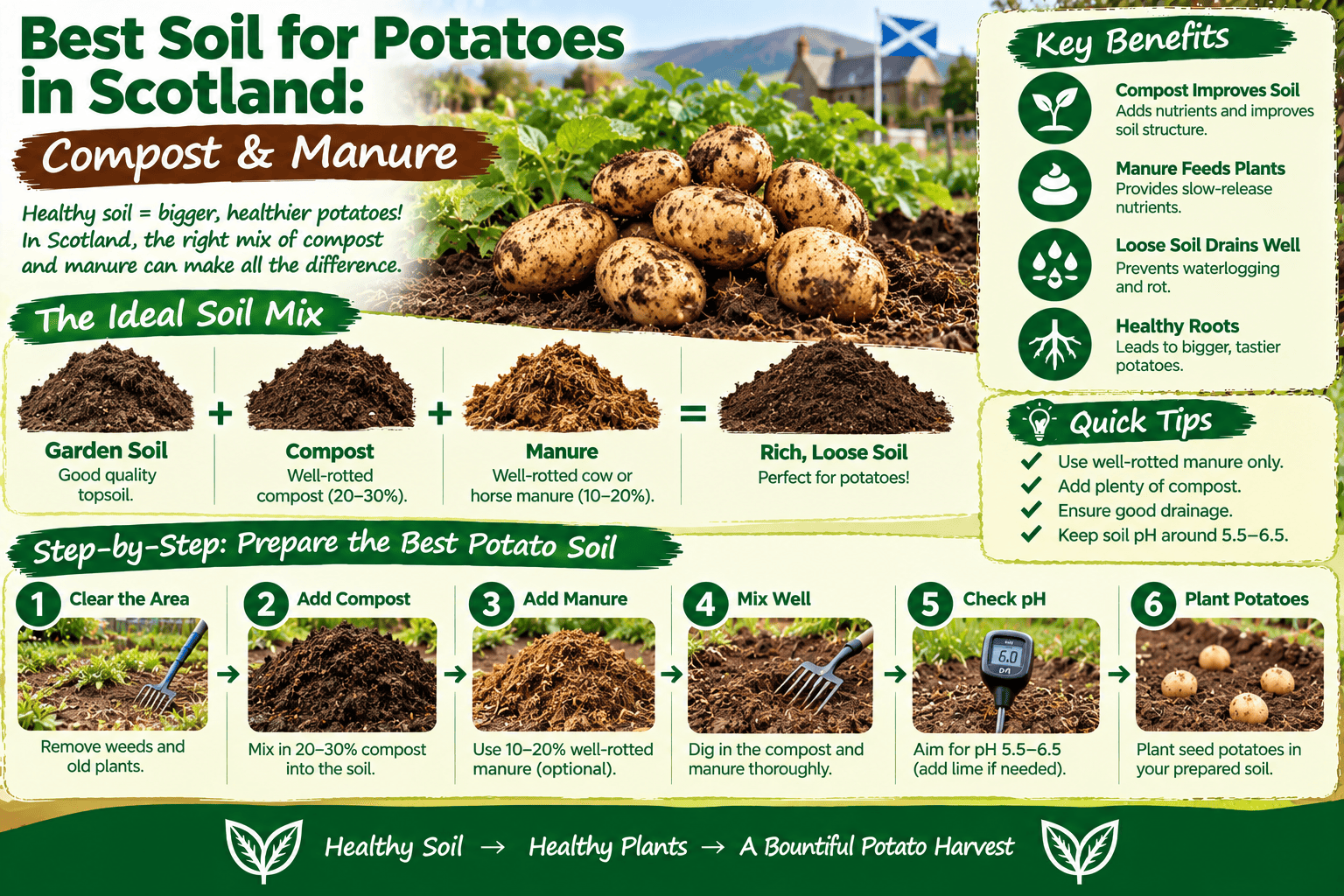
How to Prepare Soil for Growing Potatoes in Scotland: Compost, Manure & Planting Guide
Growing your own potatoes is one of the most rewarding ways to use a Scottish garden or allotment.
Whether you're planning a small vegetable patch in Glasgow, preparing an allotment in East Kilbride or growing potatoes in raised beds, good soil preparation can make a significant difference.
But what soil do potatoes actually need? Should you add compost or manure? And when should you start preparing the ground for spring planting?
Potatoes grow best in fertile, well-drained soil with sufficient depth for healthy root and tuber development. Suitable organic matter can improve soil structure, but fresh manure, excessive fertiliser and poor drainage can create problems.
This guide explains how to prepare potato-growing soil in Scotland, when to plant, how to calculate soil quantities and which garden materials may be useful.
Quick Answer: What Is the Best Soil for Growing Potatoes?
The ideal potato-growing soil is generally:
Well drained but able to retain adequate moisture.
Loose enough for developing tubers.
Free from severe compaction.
Sufficiently deep for roots and tubers.
Supplied with appropriate nutrients.
Slightly acidic, commonly around pH 5.0–6.0, although potatoes tolerate a wider range.
Potatoes can grow in clay-rich and sandy soils, but preparation requirements differ.
For many Scottish gardens, improving existing soil structure and drainage is more important than simply adding more fertiliser.
1. When Should You Prepare Soil for Potatoes in Scotland?
Autumn and early spring are both useful periods for potato-bed preparation.
Autumn: October to November
If the ground is workable, autumn can be a suitable time to clear the growing area, assess drainage and apply appropriate mature organic matter where needed.
This gives you time to identify problems before spring planting.
Avoid digging saturated soil.
Winter: December to February
During winter, focus on planning, soil testing and obtaining seed potatoes.
You can also check the condition of raised beds and calculate any materials required.
Avoid disturbing frozen or waterlogged ground.
Spring: March to April
As the soil becomes workable and temperatures improve, complete bed preparation and begin planting when conditions are suitable.
In colder or exposed Scottish locations, planting may need to be later.
2. Can You Grow Potatoes in Glasgow's Clay Soil?
Yes.
Potatoes can grow in clay-rich soil, but heavy compaction and poor drainage can affect establishment and harvesting.
Clay soil can retain nutrients and moisture well.
However, when saturated, it may contain insufficient air for healthy roots.
How to improve clay soil for potatoes
Start by checking drainage and compaction.
Where appropriate:
Avoid walking on wet growing beds.
Remove large stones and unwanted debris.
Incorporate suitable mature organic matter when the soil is workable.
Avoid breaking up saturated clay.
Consider raised beds if the existing soil is unsuitable.
Monitor moisture during the growing season.
Adding sand without a properly designed soil-improvement plan is not a universal solution for clay.
3. Should You Add Compost Before Planting Potatoes?
Mature organic compost can be useful for improving suitable potato-growing soil.
It contributes organic matter and may help improve structure, moisture retention and biological activity.
However, compost also contributes nutrients.
The correct quantity depends on soil fertility and previous applications.
If you've added substantial amounts of compost or manure in recent years, another heavy application may not be necessary.
Compost vs potting compost
Bulk garden compost is generally intended as a soil improver.
It isn't necessarily suitable as the sole growing medium in containers.
For potatoes in pots or growing bags, use an appropriate container-growing medium.
Explore Kelvin Compost's organic compost for suitable garden soil-improvement projects.
4. Is Manure Good for Growing Potatoes?
Well-rotted manure can contribute organic matter and nutrients to suitable potato-growing soil.
However, there are important precautions.
Fresh or insufficiently decomposed manure can create plant-health and food-safety concerns.
Heavy manure applications may also contribute to nutrient imbalances.
Potatoes are particularly susceptible to common scab under certain soil conditions, including relatively high soil pH and dry conditions during early tuber development.
Avoid unnecessary liming before planting potatoes, and don't assume manure will automatically improve the crop.
Where manure is used, choose suitable well-rotted material and apply it according to soil needs and good food-growing practice.
Kelvin Compost offers manure for appropriate garden applications.
5. Compost or Manure: Which Is Better for Potatoes?
Both materials can be useful, but neither is automatically the best choice.
| Material | Main purpose | Important consideration |
|---|---|---|
| Mature compost | Improves soil organic matter and structure | Avoid excessive nutrient additions |
| Well-rotted manure | Adds organic matter and nutrients | Maturity, nutrient content and food safety matter |
| Topsoil | Provides mineral soil volume | Must be suitable for growing |
| Container compost | Growing medium for pots and bags | Choose a suitable formulation |
| Fertiliser | Supplies specific nutrients | Apply according to soil and crop needs |
For an established allotment, mature compost may be sufficient.
For a new raised bed lacking suitable soil depth, topsoil or an appropriate growing blend may be necessary.
For nutrient-deficient soil, fertiliser requirements should ideally be informed by testing.
6. What Soil pH Do Potatoes Prefer?
Potatoes generally perform well in slightly acidic soil.
Soil pH is particularly important because common scab tends to be more problematic under relatively alkaline conditions.
Avoid applying lime immediately before a potato crop unless a soil test and crop-management plan justify it.
If you grow several crops in rotation, consider their different pH requirements.
Don't attempt to acidify soil blindly.
Excessive amendments can create other nutrient and soil-health problems.
7. How Deep Should Soil Be for Growing Potatoes?
Potatoes need sufficient soil depth for roots and developing tubers.
The required depth depends on the variety, growing system and existing soil.
For container growing, choose a sufficiently deep container with appropriate drainage.
For raised beds, ensure there's enough suitable growing medium to support the crop and allow earthing up where necessary.
Don't confuse the depth at which a seed potato is initially planted with the total depth of soil needed for the crop.
8. How to Prepare a Potato Bed Step by Step
Step 1: Choose a suitable location
Select an area with good sunlight and suitable drainage.
Avoid ground where water remains standing for prolonged periods.
Step 2: Check crop rotation
Where possible, avoid growing potatoes repeatedly in the same soil.
Rotating crops can help manage certain soil-borne pests and diseases.
Step 3: Remove weeds
Clear persistent weeds before planting.
Perennial weeds can compete with potatoes and make harvesting difficult.
Step 4: Assess soil structure
Check whether the ground is compacted, shallow or poorly drained.
Correct major physical problems before adding amendments.
Step 5: Test the soil
A soil test can help identify pH and nutrient requirements.
Step 6: Add suitable organic matter if needed
Use mature compost or appropriate well-rotted manure based on the soil's condition.
Avoid unnecessary heavy applications.
Step 7: Prepare the planting surface
When the soil is workable, create an even, loose growing area without excessively disturbing its structure.
Step 8: Plant at the appropriate time
Follow the spacing and depth guidance for your potato variety and growing method.
9. When to Plant Potatoes in Scotland
Planting dates vary with local weather, soil conditions and variety.
As a general guide:
| Potato type | Approximate planting period in Scotland | Harvest timing |
|---|---|---|
| First earlies | March–April, conditions permitting | Early summer |
| Second earlies | April | Summer |
| Maincrop | April–May | Late summer to autumn |
These are broad seasonal windows, not guaranteed planting dates.
Cold, wet soil can delay planting, particularly in exposed areas.
Follow the seed-potato supplier's recommendations and monitor local conditions.
10. Should You Chit Seed Potatoes?
Chitting means allowing seed potatoes to develop short shoots before planting.
It is commonly used for early potato varieties.
To chit potatoes, place suitable certified seed potatoes in a cool, bright, frost-free location with the eyes facing upwards where practical.
Avoid excessive warmth, which can produce long, weak shoots.
Chitting is optional for some growing systems and isn't a substitute for good soil preparation.
11. How Far Apart Should You Plant Potatoes?
Spacing depends on the variety and whether you're growing earlies or maincrop potatoes.
As a general guide:
First earlies: approximately 30cm between plants and 60cm between rows.
Maincrop: approximately 35–40cm between plants and 75cm between rows.
Check the specific seed-potato instructions, as recommended spacing varies.
Allow enough room to earth up the plants and access them for maintenance.
12. Can You Grow Potatoes in Raised Beds?
Yes.
Raised beds can be useful where existing garden soil is shallow, compacted or unsuitable.
However, a raised bed must still have adequate drainage and an appropriate growing medium.
Avoid filling a deep raised bed entirely with pure soil-improving compost unless the material is specifically formulated and suitable for that purpose.
A balanced growing medium containing appropriate mineral soil and organic matter is often more suitable.
For new raised-bed projects, Kelvin Compost supplies topsoil and organic compost.
13. Can You Grow Potatoes in Bags or Containers?
Yes, provided the container is large enough and drains properly.
Container growing can be practical for smaller Glasgow gardens, patios and courtyards.
Use a suitable growing medium and follow the seed supplier's guidance on planting density.
Avoid overcrowding.
Container potatoes can dry out more quickly than plants growing in the ground, so monitor moisture regularly.
14. How Much Topsoil Do You Need for a Potato Raised Bed?
If you're creating a raised bed, calculate the required growing-medium volume before ordering.
Use:
Length × width × fill depth = volume in cubic metres
For example:
A raised bed measuring 2m long, 1m wide and 30cm deep has a volume of:
2 × 1 × 0.30 = 0.6m³
That's 600 litres of growing medium.
Raised-bed volume calculator
| Bed dimensions | Fill depth | Approximate volume |
|---|---|---|
| 1m × 1m | 30cm | 300L |
| 2m × 1m | 30cm | 600L |
| 3m × 1m | 30cm | 900L |
| 4m × 1m | 30cm | 1,200L |
| 4m × 1.2m | 40cm | 1,920L |
These are mathematical fill volumes, not universal recommended depths or growing-medium recipes.
Allow for settlement and check the actual capacity of any bulk bags you order.
15. How Often Should You Water Potatoes?
Potatoes need adequate moisture, particularly during tuber formation.
However, overwatering can contribute to problems in poorly drained soil.
In Scotland, rainfall may supply much of the required water during some periods.
During dry weather, additional watering may be necessary.
Aim for reasonably consistent moisture rather than alternating between severe drought and saturation.
16. Do Potatoes Need Fertiliser?
Potatoes require nutrients, including potassium, for healthy growth.
However, the correct fertiliser depends on existing soil fertility.
Applying large quantities without testing can be wasteful or harmful.
Where a nutrient deficiency is confirmed or reasonably expected, select a fertiliser appropriate for potatoes and follow its instructions.
Avoid assuming that all potato beds require the same treatment.
17. What Is Earthing Up Potatoes?
Earthing up means drawing suitable soil around developing potato stems.
This helps protect developing tubers from exposure to light.
Light-exposed potatoes can turn green and may accumulate higher levels of glycoalkaloids.
Do not eat green potatoes or those showing significant greening.
Earthing up can also provide some protection to emerging shoots against light frost.
18. Common Problems When Growing Potatoes in Scotland
Potato blight
Potato blight can develop in suitable humid weather conditions.
Choose appropriate varieties, monitor plants and follow current horticultural advice.
Common scab
This can affect the appearance and surface of potato tubers.
Soil pH and moisture management are relevant factors.
Waterlogging
Persistently saturated soil can restrict root growth and contribute to tuber problems.
Slug damage
Slugs can damage developing potatoes.
Use an integrated approach to management rather than relying on a single treatment.
Green potatoes
Tubers exposed to light may turn green.
Maintain adequate soil cover and avoid eating green potatoes.
19. Can You Grow Potatoes in the Same Place Every Year?
It's generally better to rotate potato crops where space permits.
Growing potatoes repeatedly in the same soil can increase the risk of certain pests and diseases.
A rotation involving other crop families can help reduce some problems, although it doesn't eliminate every disease risk.
Avoid planting potatoes immediately after closely related crops such as tomatoes where relevant disease concerns exist.
20. What Should You Do After Harvesting Potatoes?
Remove the crop carefully and avoid leaving unwanted tubers in the ground.
Volunteer potatoes can carry problems into future seasons.
Check soil condition before planning the next crop.
If appropriate, consider a different crop family in the following season.
Don't automatically add more compost or manure without considering the soil's existing fertility.
Potato Growing in Glasgow, East Kilbride and South Lanarkshire
Gardeners across the Glasgow area face different soil conditions.
Some allotments have productive, established growing soil.
Others contain compacted clay, shallow topsoil or poorly drained ground.
For successful potato growing, the priorities are similar:
Choose a suitable location.
Check soil drainage.
Prepare the growing area when conditions allow.
Use appropriate organic matter where needed.
Avoid excessive fertiliser and fresh manure.
Plant at the right time for local conditions.
Maintain adequate moisture.
Rotate crops where practical.
If your project requires additional soil or suitable organic matter, calculate the quantity before ordering.
Frequently Asked Questions
What is the best soil for potatoes in Scotland?
Fertile, well-drained soil with sufficient depth and suitable structure is generally best.
Can you grow potatoes in clay soil?
Yes, but compaction and poor drainage may need attention.
Is compost good for growing potatoes?
Mature compost can improve suitable soil, but excessive applications should be avoided.
Is manure good for potatoes?
Appropriate well-rotted manure can be useful, but maturity, nutrient content and application timing matter.
Can you use fresh manure for potatoes?
Fresh manure is generally best avoided immediately before growing potatoes, particularly because of crop-quality and food-safety considerations.
What month do you plant potatoes in Scotland?
Many varieties are planted between March and May, depending on type and local conditions.
Can you plant potatoes in February?
Outdoor planting is generally too early in many Scottish gardens, although protected growing systems may differ.
Do potatoes need acidic soil?
Potatoes generally prefer slightly acidic conditions, and relatively high pH can increase common-scab risk.
Can you grow potatoes in raised beds?
Yes, with sufficient depth, drainage and suitable growing medium.
Can you grow potatoes in containers?
Yes. Choose an appropriately sized container and suitable growing medium.
How deep should you plant potatoes?
Planting depth varies by variety and growing method. Follow seed-potato supplier guidance.
Should you add lime before planting potatoes?
Avoid unnecessary liming, particularly because higher soil pH can increase common-scab risk.
How much compost do potatoes need?
There is no universal amount. Soil fertility and previous organic-matter applications should guide the decision.
Is topsoil or compost better for potato raised beds?
Topsoil provides mineral soil volume, while compost contributes organic matter. An appropriate growing blend may be useful.
How long do potatoes take to grow?
Depending on the variety and conditions, potatoes may take roughly 10–20 weeks or longer from planting to harvest.
Can you grow potatoes in November in Scotland?
November isn't normally a suitable time for planting an outdoor potato crop intended to establish through winter.
Final Thoughts: Good Potatoes Start With Good Soil
Growing potatoes in Scotland doesn't require perfect garden soil.
But it does require understanding the ground you're planting into.
Compacted soil, poor drainage and inappropriate fertiliser applications can all affect the crop.
Mature compost may help improve suitable soil.
Well-rotted manure can contribute organic matter and nutrients where appropriate.
And if you're creating a new raised bed, suitable topsoil may provide the mineral growing volume you need.
Prepare the soil carefully, plant when conditions are right and avoid adding more amendments than your crop actually requires.
Need Compost, Manure or Topsoil in Glasgow?
Kelvin Compost supplies garden materials for vegetable growing, allotments, raised beds and landscaping projects across Glasgow, East Kilbride, South Lanarkshire and surrounding areas.
Explore our products:
For product quantities and delivery enquiries:
Phone: +44 7561 251350
Email: info@kelvincompost.co.uk
Need Garden Supplies Delivered in Glasgow?
Organic compost, topsoil, manure and more across Scotland