



Best Soil for Growing Vegetables UK – Glasgow Guide
Looking for compost, topsoil or garden supplies?
Browse our full product range or get in touch for delivery across Glasgow and Scotland.
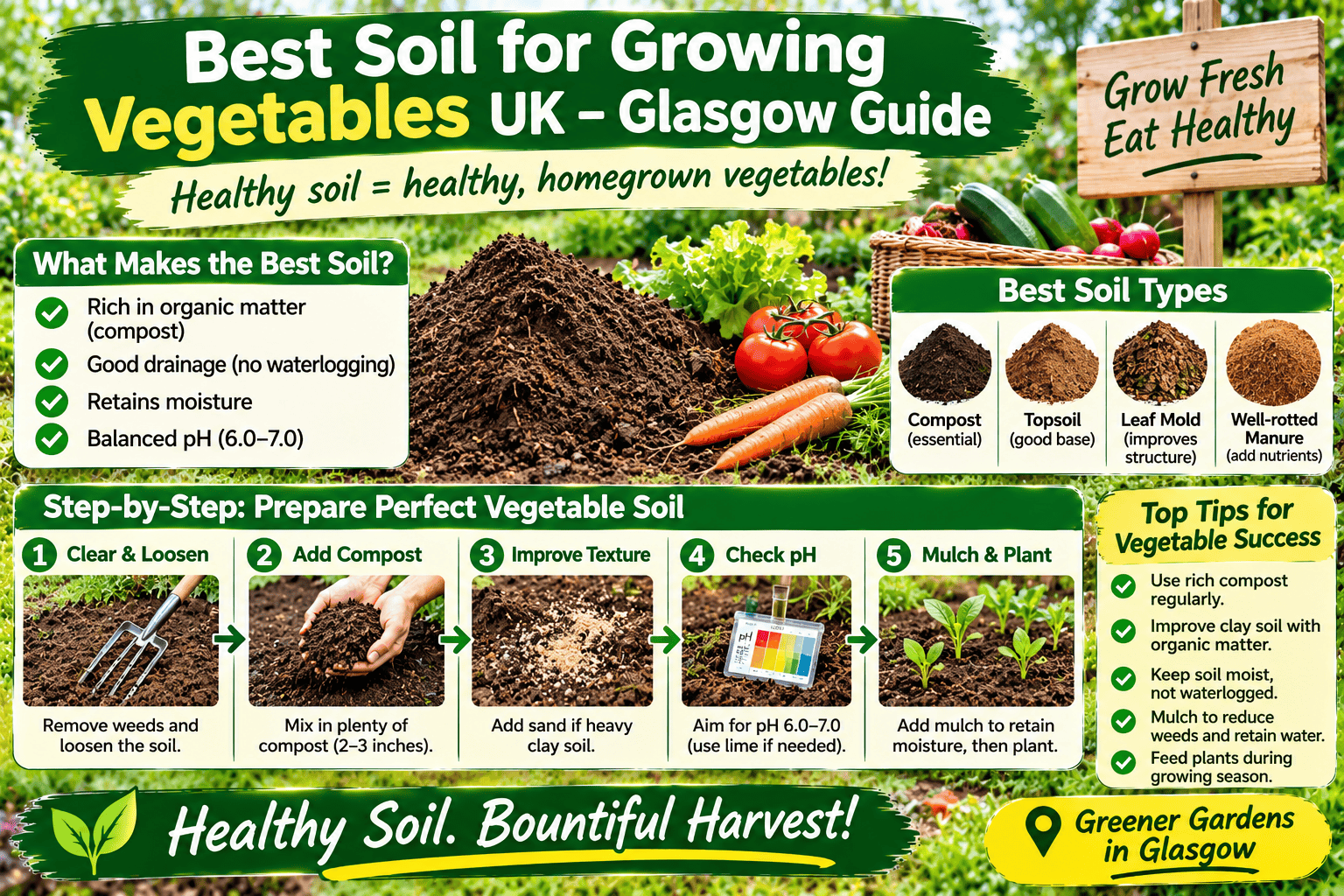
Best Soil for Growing Vegetables in the UK: Complete Guide for Glasgow & Scotland
Growing your own vegetables can be rewarding, economical and enjoyable. However, successful vegetable gardening starts with choosing the right soil.
Whether you're growing potatoes, carrots, tomatoes, onions or leafy vegetables, the quality and condition of your soil can influence plant development and harvests.
The best soil for growing most vegetables is fertile, well-drained soil with a suitable balance of mineral particles, organic matter, moisture and nutrients. Mature organic compost can help improve existing garden soil, while suitable topsoil provides additional growing depth where required.
For gardeners in Glasgow and across Scotland, preparing the soil correctly is particularly important because wet winters, heavy clay and cooler growing conditions can make vegetable cultivation challenging.
At Kelvin Compost, we supply organic compost, topsoil, manure and woodchip for vegetable gardens, allotments and raised beds across Glasgow and surrounding areas.
This guide explains which materials to buy, how to prepare your vegetable garden and how much soil or compost you may need.
What Is the Best Soil for Growing Vegetables?
Most vegetables grow well in suitable loamy soil containing a balanced mixture of sand, silt, clay and organic matter.
Good vegetable-growing soil should generally provide:
Adequate rooting depth.
Suitable drainage.
Sufficient moisture retention.
Appropriate nutrient availability.
Good soil structure.
A suitable pH for the crops being grown.
Space for roots to develop.
Different vegetables have different requirements, so there is no single growing medium that is perfect for every crop.
However, improving existing soil with suitable mature organic matter is often a practical starting point.
Shop Organic Compost for Vegetable Gardens
Which Garden Soil Should You Buy for Vegetables?
Choosing the correct product depends on your existing garden and what you intend to grow.
| Garden requirement | Material to consider |
|---|---|
| Improving existing vegetable beds | Organic compost |
| Filling new raised beds | Suitable topsoil and compost mixture |
| Increasing organic matter and nutrients | Well-rotted manure |
| Creating new vegetable-growing areas | Suitable garden topsoil |
| Protecting exposed soil | Appropriate organic mulch |
| Creating paths between vegetable beds | Woodchip |
If your existing garden already contains sufficient suitable soil, you may not need to purchase additional topsoil.
Instead, mature compost may help improve the soil you already have.
1. Organic Compost for Growing Vegetables
Organic compost is a valuable material for many vegetable gardens.
It contributes organic matter and supports soil biological activity, which can help maintain suitable soil structure over time.
Appropriate compost applications can help:
Improve soil workability.
Support root development.
Maintain soil organic matter.
Improve moisture management.
Contribute nutrients.
Protect exposed soil when used as mulch.
Mature compost is particularly useful when preparing established vegetable beds for another growing season.
How to use compost in vegetable gardens
Remove established weeds and assess the existing soil.
Apply a suitable quantity of mature compost to the surface or incorporate it gently where appropriate.
Avoid cultivating saturated soil, particularly during Scotland's wetter months.
The correct application rate depends on existing fertility, compost characteristics and crop requirements.
Buy Bulk Organic Compost in Glasgow
2. Topsoil for Vegetable Gardens and Raised Beds
Topsoil provides mineral soil and additional rooting depth.
It can be particularly useful when establishing a new vegetable garden, filling raised beds or improving gardens with insufficient suitable growing soil.
Topsoil and compost serve different purposes.
Topsoil provides the mineral foundation, while compost contributes organic matter.
When should you buy topsoil?
Consider ordering suitable topsoil if:
Your raised beds need filling.
Your garden has insufficient growing depth.
You are creating a new vegetable-growing area.
Existing ground contains unsuitable construction material.
You are establishing a larger allotment or community garden.
Before placing topsoil over existing ground, investigate drainage and compaction.
Adding new soil will not automatically resolve persistent waterlogging.
Order Garden Topsoil in Glasgow
3. Well-Rotted Manure for Growing Vegetables
Well-rotted manure can contribute organic matter and plant nutrients to suitable vegetable-growing soils.
It may be particularly useful for crops with substantial nutrient requirements.
However, manure should be used carefully.
Not all vegetables benefit from recently manured ground, and excessive applications can create nutrient imbalances.
Use appropriately matured material and follow suitable food-safety guidance when growing edible crops.
Which vegetables may benefit from manure?
Depending on existing soil fertility, suitable manure applications may benefit crops such as:
Cabbages.
Brussels sprouts.
Broccoli.
Courgettes.
Pumpkins.
Other nutrient-demanding vegetables.
Carrots and parsnips are generally better grown in soil that has not been freshly manured, as unsuitable soil conditions can contribute to misshapen roots.
Buy Well-Rotted Manure for Vegetable Gardens
Best Soil for Different Types of Vegetables
Choosing soil according to the crops you intend to grow can help you avoid unnecessary amendments.
| Vegetable | Preferred soil characteristics |
|---|---|
| Potatoes | Loose, fertile, well-drained soil |
| Carrots | Deep, fine-textured, stone-free soil |
| Tomatoes | Fertile, well-drained growing medium |
| Onions | Firm, fertile, well-drained soil |
| Garlic | Free-draining soil with suitable fertility |
| Cabbage | Fertile soil with suitable pH |
| Lettuce | Moisture-retentive but well-drained soil |
| Peas | Well-drained soil without excessive nitrogen |
| Courgettes | Fertile soil with adequate moisture |
| Beetroot | Workable, well-drained soil |
| Parsnips | Deep soil without excessive stones or fresh manure |
| Spinach | Fertile soil with consistent moisture |
Always consider the specific variety, planting method and existing soil conditions.
Best Soil for Growing Potatoes in Scotland
Potatoes are a popular crop for Scottish vegetable gardens and allotments.
They generally prefer loose, well-drained soil that allows tubers to develop without excessive restriction.
Heavy, compacted or persistently waterlogged soil can make potato cultivation difficult.
Before planting potatoes:
Assess soil drainage.
Remove established weeds.
Prepare suitable rooting depth.
Add appropriate organic matter if needed.
Avoid working saturated soil.
Suitable mature compost can help maintain soil structure, while additional topsoil may be useful where growing depth is insufficient.
Avoid unnecessary liming immediately before potatoes, as higher soil pH can increase the risk of common scab in susceptible conditions.
Best Soil for Growing Carrots
Carrots generally prefer deep, workable soil without excessive stones, large clods or compacted layers.
Heavy clay soil can make it difficult for roots to develop evenly.
For better growing conditions:
Remove stones from the planting area.
Avoid fresh manure before sowing.
Prepare a suitable fine seedbed.
Choose varieties appropriate for your soil depth.
Consider raised beds where existing soil is unsuitable.
A suitable topsoil-based growing medium may be helpful when establishing a new carrot bed.
Short-rooted carrot varieties can also be useful where deep soil preparation is difficult.
Best Soil for Growing Tomatoes
Tomatoes require suitable fertility, drainage and consistent moisture.
Garden-grown tomatoes and container-grown tomatoes have different growing-medium requirements.
For tomatoes grown in outdoor beds or greenhouse borders, suitable garden soil improved with mature organic matter may be appropriate.
For tomatoes grown in containers, choose a growing medium specifically suitable for container cultivation.
Ordinary bulk topsoil or garden soil improver should not automatically be used as a complete container-growing medium.
Tomatoes also require appropriate feeding as they develop.
Avoid excessive nitrogen, which can encourage leafy growth at the expense of fruit production.
Best Soil for Growing Onions and Garlic
Onions and garlic generally prefer fertile, well-drained soil.
Persistent winter waterlogging can be particularly problematic for autumn-planted garlic.
Before planting:
Choose a suitable sunny location.
Assess drainage.
Remove established weeds.
Improve soil structure where necessary.
Avoid excessive nutrient applications.
For Glasgow gardeners with heavy clay soil, raised beds may provide an alternative growing environment where drainage is appropriately managed.
Best Soil for Growing Cabbages and Other Brassicas
Brassicas such as cabbage, broccoli, kale and Brussels sprouts generally benefit from fertile soil with suitable nutrient availability.
Soil pH is particularly relevant because acidic conditions can increase clubroot risk in affected gardens.
Test your soil before applying lime or other pH-changing products.
Mature compost and well-rotted manure may be useful where additional organic matter or nutrients are required.
Crop rotation and appropriate hygiene are also important for maintaining productive brassica beds.
What Is the Best Soil Mix for Raised Vegetable Beds?
A suitable raised-bed growing medium should provide structure, drainage, moisture retention and nutrients.
A combination of suitable mineral topsoil and mature compost can be appropriate for many outdoor raised beds.
However, the correct proportions depend on the quality of the materials, the crops and the bed construction.
Example raised-bed soil mixture
For calculation purposes, suppose a suitable growing-medium specification requires:
75% topsoil.
25% mature compost.
For a raised bed requiring 1,000 litres of growing medium, this would mean:
750 litres of topsoil.
250 litres of compost.
This is an illustrative calculation rather than a universal soil-mix recommendation.
Before ordering, assess the existing ground and confirm the materials are appropriate for the intended use.
Kelvin Compost supplies both topsoil and organic compost for suitable raised-bed projects.
How Much Soil Do I Need for a Vegetable Garden?
Calculate the required volume using:
Length × width × depth = cubic metres of soil
All measurements should be in metres.
One cubic metre equals 1,000 litres.
Example: A new raised vegetable bed
Length: 2m
Width: 1m
Fill depth: 30cm
2 × 1 × 0.30 = 0.6m³
You need approximately 600 litres of total growing medium.
Vegetable garden soil quantity table
| Growing area | 10cm additional depth | 20cm additional depth | 30cm additional depth |
|---|---|---|---|
| 5m² | 500L | 1,000L | 1,500L |
| 10m² | 1,000L | 2,000L | 3,000L |
| 15m² | 1,500L | 3,000L | 4,500L |
| 20m² | 2,000L | 4,000L | 6,000L |
| 30m² | 3,000L | 6,000L | 9,000L |
| 50m² | 5,000L | 10,000L | 15,000L |
These figures represent additional soil volume, not recommended compost application rates.
For existing vegetable gardens, you may only need an appropriate organic amendment rather than a completely new soil layer.
How Much Compost Do I Need for Vegetable Beds?
Use this formula:
Area (m²) × compost depth (cm) × 10 = litres required
For example, a 20m² vegetable garden receiving an appropriate 3cm compost layer would require:
20 × 3 × 10 = 600 litres.
| Vegetable garden size | 2cm layer | 3cm layer | 5cm layer |
|---|---|---|---|
| 5m² | 100L | 150L | 250L |
| 10m² | 200L | 300L | 500L |
| 20m² | 400L | 600L | 1,000L |
| 30m² | 600L | 900L | 1,500L |
| 40m² | 800L | 1,200L | 2,000L |
| 50m² | 1,000L | 1,500L | 2,500L |
Choose the appropriate application rate based on soil fertility and crop requirements.
For larger gardens and allotments, bulk compost delivery can reduce the need to transport numerous individual bags.
Check Organic Compost Prices and Delivery
Compost vs Manure: Which Is Better for Vegetables?
Both materials can be useful, but they have different characteristics.
| Feature | Organic compost | Well-rotted manure |
|---|---|---|
| Soil structure | Supports gradual improvement | Supports gradual improvement |
| Organic matter | Yes | Yes |
| Nutrient content | Variable | Variable, potentially substantial |
| Established vegetable beds | Often suitable | Depends on crops and fertility |
| Root vegetables | Suitable when appropriately used | Avoid freshly manured ground |
| Main purpose | Soil improvement | Organic matter and nutrient contribution |
If your main objective is improving soil structure, mature organic compost is often a practical choice.
If your soil also requires nutrients for demanding crops, well-rotted manure may be appropriate.
Avoid adding both products in large quantities without assessing existing soil fertility.
How to Prepare a Vegetable Garden for Spring 2027
Late autumn and winter provide an opportunity to plan the next growing season.
For gardeners in Glasgow, preparing early can help avoid delays when spring planting conditions become suitable.
November and December
Clear finished crops and remove diseased plant material appropriately.
Assess soil conditions and identify areas with drainage problems.
Measure any new vegetable beds you intend to create.
Avoid unnecessary cultivation when the ground is saturated.
January and February
Plan your crop rotation and decide which vegetables you want to grow.
Calculate topsoil and compost requirements.
Repair raised beds and prepare suitable delivery access.
Order materials for a suitable delivery date when ground conditions allow.
March and April
Prepare beds when the soil becomes workable.
Apply suitable mature compost where required.
Begin sowing and planting according to crop requirements, soil temperature and local weather conditions.
May and June
Continue planting suitable crops as conditions improve.
Monitor moisture, weeds and plant development.
Apply appropriate mulch and feeding where required.
Scotland's planting conditions vary considerably, so avoid relying on calendar dates alone.
How to Improve Heavy Clay Soil for Vegetable Growing
Many gardens in Glasgow contain clay-rich or compacted soil.
Although clay can retain nutrients and moisture, poor structure and drainage can make cultivation difficult.
To improve clay-rich vegetable beds:
Avoid digging saturated soil.
Apply suitable mature organic matter.
Reduce unnecessary foot traffic.
Maintain permanent paths between beds.
Investigate persistent drainage problems.
Consider raised beds where appropriate.
Organic compost can support gradual soil-structure improvement.
However, it cannot instantly transform severely compacted or persistently waterlogged ground.
Can You Grow Vegetables Without Digging the Soil?
No-dig gardening can be suitable for many established vegetable gardens.
Instead of repeatedly turning the soil, gardeners apply appropriate mature organic matter to the surface.
Soil organisms gradually incorporate organic material into the existing soil.
Potential benefits include reduced disturbance, improved surface protection and easier bed maintenance.
However, severe compaction, persistent weeds and drainage problems may require additional management.
For no-dig gardening, choose mature compost suitable for the intended application.
Using Woodchip Around Vegetable Gardens
Woodchip is particularly useful for suitable informal paths between vegetable beds.
It can help reduce exposed muddy surfaces and suppress some weeds.
However, fresh woodchip should generally remain on the surface rather than being mixed throughout vegetable-growing soil.
Example: Allotment pathways
If your paths cover 15m² and require a 7.5cm woodchip layer:
15 × 0.075 = 1.125m³.
That's 1,125 litres of woodchip.
Check ground conditions and drainage before constructing the paths.
Order Woodchip for Garden and Allotment Paths
Buying Vegetable Garden Soil in Glasgow
When purchasing garden materials, consider more than the advertised price.
Check:
Whether the product is suitable for vegetable growing.
The actual quantity supplied.
Whether you need topsoil, compost or manure.
The total delivered price.
Delivery availability for your postcode.
Vehicle access and unloading arrangements.
The condition of your existing garden soil.
For larger projects, compare bulk delivery with purchasing multiple smaller bags.
Buying the correct material and quantity can help avoid unnecessary expense.
Bulk Vegetable Garden Compost Delivery in Scotland
Kelvin Compost supplies garden materials for homeowners, allotment holders, community gardens and landscaping projects across Glasgow and surrounding areas.
Delivery enquiries are welcome from customers in:
Glasgow.
East Kilbride.
Hamilton.
Cambuslang.
Rutherglen.
Newton Mearns.
Clarkston.
South Lanarkshire.
Surrounding areas of Scotland.
Confirm delivery availability and charges for your postcode before placing an order.
Whether you're creating one raised bed or preparing a larger vegetable garden, Kelvin Compost supplies a range of materials for suitable growing and landscaping applications.
Frequently Asked Questions
What is the best soil for growing vegetables in the UK?
Suitable fertile, well-drained loamy soil with appropriate organic matter is a good starting point for many vegetables.
What is the best compost for growing vegetables?
Mature compost suitable for garden soil improvement can be beneficial for vegetable beds. Container-grown vegetables require an appropriate container-growing medium.
Can I grow vegetables in topsoil?
Yes, provided the topsoil is suitable for growing and offers appropriate structure, drainage and fertility.
Can I fill raised beds with just compost?
Pure compost is not automatically suitable for every raised bed. A balanced growing medium containing suitable mineral soil may be more appropriate.
Is manure good for vegetable gardens?
Well-rotted manure can benefit suitable crops and soils when applied at appropriate rates with food-safety precautions.
How much soil do I need for a 2m by 1m raised bed?
At a fill depth of 30cm, the bed requires approximately 600 litres of growing medium.
Can I prepare vegetable beds in winter in Scotland?
Yes. Winter is useful for planning, measuring and assessing soil conditions. Avoid cultivating saturated or frozen ground.
What soil is best for carrots?
Deep, workable, relatively stone-free soil that has not been freshly manured is generally suitable.
How often should I add compost to vegetable beds?
This depends on existing soil fertility, organic matter, compost characteristics and crop requirements. Assess the soil before applying additional material.
Where can I buy vegetable garden soil in Glasgow?
Kelvin Compost supplies topsoil, organic compost, manure and woodchip for suitable garden projects across Glasgow and surrounding areas.
Prepare Your Vegetable Garden With Kelvin Compost
A productive vegetable garden starts with suitable soil.
Whether you're preparing an allotment, building raised beds, growing potatoes or planning your spring vegetable garden, choosing the right material can help create better growing conditions.
Kelvin Compost supplies garden materials for both small domestic projects and larger gardening requirements.
Shop garden materials online
Order bulk garden materials in Glasgow
Prepare your garden for the next growing season with Kelvin Compost.
Visit www.kelvincompost.co.uk to explore our products, check current prices and confirm delivery to your postcode.
Phone: +44 7561 251350
Email: info@kelvincompost.co.uk
Start preparing your vegetable garden today and give your next growing season the right foundation.
Need Garden Supplies Delivered in Glasgow?
Organic compost, topsoil, manure and more across Scotland