



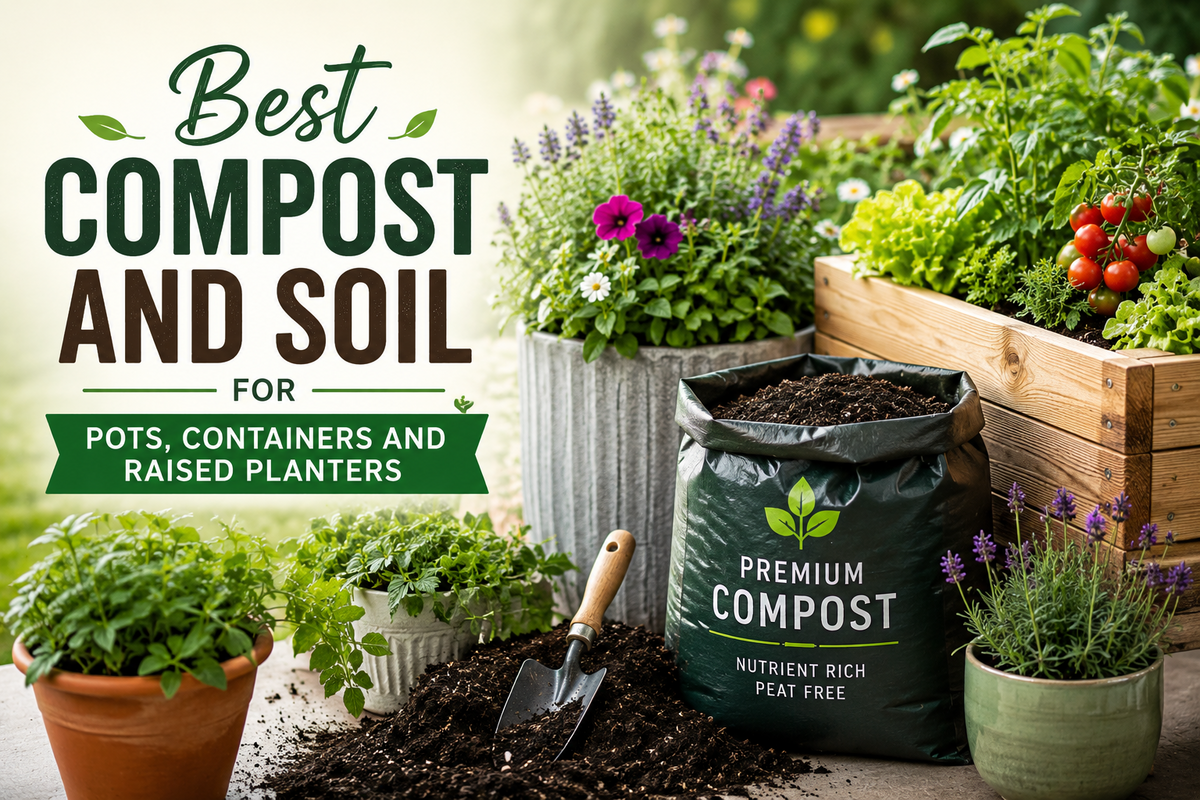
Best Compost and Soil for Pots, Containers and Raised Planters
Looking for compost, topsoil or garden supplies?
Browse our full product range or get in touch for delivery across Glasgow and Scotland.
Quick answer: For pots and containers, use a peat-free multi-purpose or container compost rather than garden compost or topsoil — container plants rely entirely on what's in the pot, so they need a lighter, free-draining mix with consistent structure. A 40-litre bag typically fills two to three medium pots (30–40cm diameter), while a 300–400 litre planter needs closer to 4–5 bags or roughly half of one 850-litre bulk bag. Refresh the top third of container compost annually rather than replacing it completely each year.
Pots and planters are the one area of the garden where the usual bulk-buying advice doesn't really apply — the material has to work harder, because unlike a bed or border, container plants have no surrounding soil to draw extra nutrients or moisture from. This guide covers what actually belongs in a container, how much you need for different pot sizes, and how that differs from what goes in a raised bed.
What's the difference between garden compost and container/potting compost?
Garden compost is designed to improve and feed existing soil in beds and borders, while container or potting compost is a standalone growing medium engineered to hold the right balance of moisture, air and nutrients on its own, since there's no surrounding soil to compensate. Using straight garden compost in a pot often leads to waterlogging, poor drainage, and compacted roots, because garden compost isn't formulated to structure itself the way potting mixes are.
| Compost type | Best use | Why it works there |
|---|---|---|
| Garden/organic compost | Beds, borders, mulching, digging into existing soil | Feeds and improves soil already present |
| Multi-purpose potting compost | General pots, containers, hanging baskets | Balanced structure, holds moisture without waterlogging |
| Container/planter compost | Larger planters, raised containers | Slightly coarser structure for better long-term drainage in bigger volumes |
| Ericaceous compost | Acid-loving plants in pots (azaleas, blueberries, camellias) | Lower pH suited to specific plant families |
| Topsoil/compost blend | Large raised planters (50cm+ deep) | Structural base for bigger volumes, topped with compost |
How much compost do I need for pots and containers?
Container compost is usually sold and measured in litres per bag rather than by bulk delivery, and the amount needed scales with pot diameter and depth rather than garden area.
| Pot/planter size | Approx. volume | Bags needed (40L bags) |
|---|---|---|
| Small pot (20–25cm) | 10–15L | Part of one bag |
| Medium pot (30–40cm) | 25–40L | 1 bag |
| Large pot (50cm+) | 60–80L | 2 bags |
| Window box | 10–15L | Part of one bag |
| Hanging basket | 5–10L | Part of one bag |
| Raised planter (1m × 0.5m, 40cm deep) | 200L | 5 bags |
| Large raised planter (1.5m × 1m, 50cm deep) | 750L | Approx. one 850L bulk bag |
For raised planters over roughly 300–400 litres, buying compost in bulk works out considerably cheaper per litre than multiple small bags, and is worth arranging as a delivery rather than a garden centre trip.
Should I use topsoil in a large planter?
For planters deeper than about 40–50cm, a topsoil base topped with potting or container compost in the upper 20–30cm (where most roots sit) is more cost-effective than filling the entire depth with potting compost, and works just as well for most plants. This mirrors the approach used for raised beds — topsoil provides bulk and structure lower down, while compost near the surface handles nutrition and moisture for the root zone.
Do container plants need different compost to bedding plants?
Yes — container plants rely entirely on the compost around their roots for both nutrients and moisture, since there's no wider soil to draw from, so they generally need a richer, more consistent mix than plants going straight into a garden bed. This is also why container compost tends to need replacing or refreshing more often than garden soil, which naturally regenerates nutrients over time through soil biology that a contained pot doesn't have.
How often should I change compost in pots and planters?
Refresh the top third of the compost annually for permanent or long-lived container plants such as shrubs and perennials, and replace the compost entirely each year for annual bedding plants and vegetables grown in containers, since the compost's nutrients and structure break down significantly over a single growing season. For large raised planters that aren't emptied each year, an annual top-dressing with fresh compost achieves a similar effect without the labour of a full replacement.
Can I reuse old container compost?
Yes, with some improvement — old container compost can usually be reused for less demanding plants after mixing in fresh compost (roughly 50/50) and, if needed, a slow-release fertiliser, since a full season of growth depletes most of the readily available nutrients. Compost that's become compacted, waterlogged, or has visible pest or disease issues is better replaced entirely rather than reused.
Is Kelvin compost suitable for pots and containers?
Our bulk Organic Compost is best suited to garden beds, borders and larger raised planters rather than small individual pots, where a dedicated multi-purpose or container compost is generally the better choice for structure and drainage. For larger raised planters and container growing at scale — allotments, community gardens, or multiple raised planters in one project — our bulk delivery works out considerably more cost-effective than buying bagged potting compost in the same volume.
Ordering compost for large planters and raised containers in Glasgow
- Measure your planter's volume using length × width × depth, converted to litres
- For planters under roughly 300L, bagged multi-purpose or container compost from a garden centre is usually simplest
- For larger planters or multiple containers, order Organic Compost in bulk through our product pages, or call +44 7561 251350
We deliver across Glasgow, East Kilbride and South Lanarkshire (£15 local delivery in East Kilbride and surrounding areas), with quotes available for the wider Central Belt.
Frequently Asked Questions
Can I use garden compost instead of potting compost in containers? It's not ideal — garden compost is formulated to improve existing soil, not to work as a standalone growing medium, and often drains poorly or compacts when used alone in a pot. It's a better fit for larger raised planters blended with topsoil than for smaller individual pots.
How much compost does a raised planter need compared to a raised bed? The calculation is the same — length × width × depth in metres, multiplied by 1,000 for litres — but planters are often deeper relative to their footprint than garden raised beds, so don't assume the per-square-metre figures from bed guides apply directly.
Do vegetables in containers need different compost to flowers? Vegetables in containers generally need a richer, more consistent feed than ornamental flowers, since they're actively fruiting or producing edible growth throughout the season — a vegetable-specific or multi-purpose compost with added feed usually performs better than a basic potting mix.
Is peat-free compost as good as peat-based for containers? Yes, modern peat-free container composts perform comparably to peat-based mixes for most plants, though watering little and often tends to suit peat-free mixes slightly better than the occasional deep soak that worked with older peat-based composts.
How deep does a raised planter need to be for vegetables? Most vegetables need at least 30–40cm of growing depth, with deeper-rooting crops like tomatoes and squash benefiting from 40–50cm or more.
Need Garden Supplies Delivered in Glasgow?
Organic compost, topsoil, manure and more across Scotland